Cosmetics display ideas for a face cream launch, from brief to counter
Cosmetics display ideas for a face cream launch in beauty stores, a counter display, a glorifier and a shelf frame, and how they come out of one brief with Bellto.
In this article
I built this case with Pielmar, a fictional skincare brand for perfume and beauty stores that I use on this blog. Its face cream comes in a frosted glass jar with an aqua lid, inside a sand-colored carton, and the brand sits in accessible luxury.
Bellto is an AI agent that designs your brand's POP. It reads the campaign brief, creates every piece with your product and takes you all the way to the manufacturer's quote. Every image in this case was designed by Bellto from the brief, with Pielmar's jar and carton as the product.
An accessible luxury brief for 200 beauty stores
I have spent almost 4 years in the POP industry, and in cosmetics the brief has to answer two questions before any other. What the store lets you put in, and how the brand has to look. The first one bounds the pieces, and the second one decides the material and the finish.
BriefPielmarfictional brand
- Product
- Crema hidratante 24 h, a 24-hour moisturizer with marine minerals, 50 ml glass jar in its carton
- Channel
- perfume and beauty stores
- Stores
- about 200 stores in Spain
- Dates
- March to June
- Space
- its section of the facial care shelf and a spot on the checkout counter in all of them, plus the new-in table during the launch in about 40
- Positioning
- accessible luxury, with a matte finish, a touch of pearl foil and very little copy
- Artwork
- the brand's sand, aqua and pearl white
- Lifespan
- the counter and shelf pieces last one season, and the glorifier stays on the shelf afterward
- Copy
- what the pack says
- Logistics
- one shipment per store, put in place by the store staff
The space line is the same as in any channel. Pielmar has its shelf and the register in all 200 stores, and a starring spot only in the 40 that give it the new-in table. That is why two pieces go to every store and one only to those 40.
The positioning line is the one that weighs most in cosmetics. An accessible luxury brand cannot show up in a beauty store with a piece that looks like it belongs in a supermarket, and that decides the material and the finish before the budget does. In beauty, cardboard can get expensive, because it carries matte and metallic textures, internal reinforcement so the structure does not look flimsy and, sometimes, acrylic parts.
In Bellto, that brief is the campaign's shared brief, and each piece has its own spec sheet. If the dates or the store count change, they change in one place and hold for all three pieces.
Three places in the beauty store
The selective channel is where a face cream at this price competes with the most brands at once. These are the market figures for Spain.
All four figures come from Stanpa, Spain's national perfume and cosmetics association, and they cover 2025. For a new cream, its report has one more figure that matters as much. In the selective channel, skin care grew 1% that year, while face makeup grew 12.1%. A face cream enters the beauty store in a category that is barely growing, and it wins its spot from the creams already on the shelf.
A beauty store has three places where a face cream can be during its launch, and each Pielmar piece works one of them.
| Piece | Where it goes | What it does | Stores |
|---|---|---|---|
| Counter display | on the checkout counter | shows the jar while the shopper waits and pays | 200 |
| Glorifier | on the new-in table, then on the shelf | presents a single jar as the star | 40 |
| Shelf frame | around Pielmar's shelf in the facial care section | makes the brand's row read as one block | 200 |
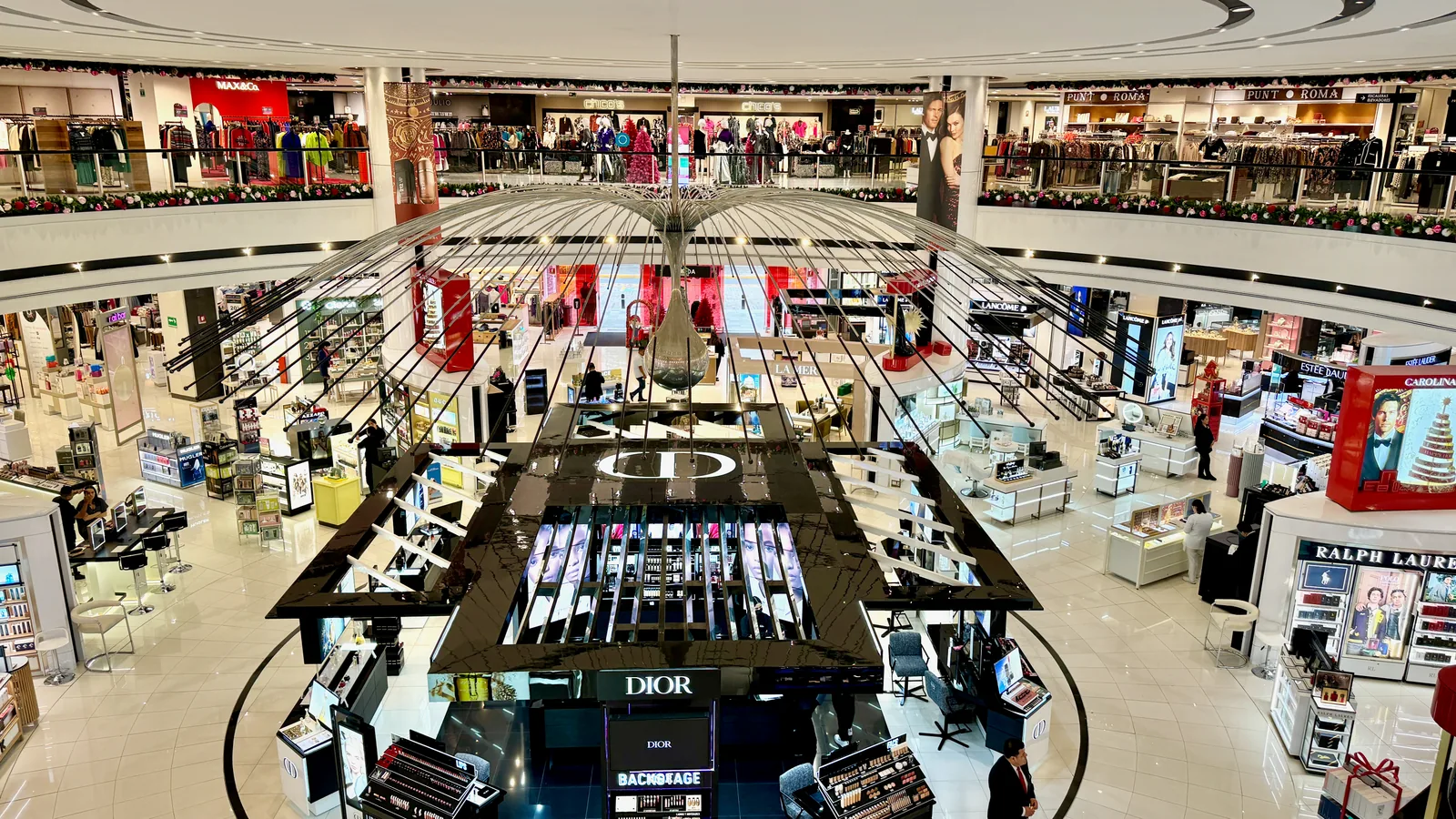
The photo shows how space gets split in a large cosmetics hall. Each brand has its island, its fixture or its stretch of wall, and the shopper walks past all of them. A street beauty store is smaller, but the split is the same, and a brand launching a cream has to stand out inside the space that is already its own.
The counter display, by the register
Counter displayPielmar counter display
- Material
- matte-finish cardboard with an acrylic base
- Product
- 50 ml jars without the carton, in two rows
- Where
- on the checkout counter
- Quantity
- 200, one per store
- Assembly
- put in place by the store staff
At a beauty store register, people wait and pay, and the piece competes with everything the store puts in front of the shopper. It has to be small, because that counter is also where staff ring up and wrap, and it has to show the jar out of its carton, which is how people recognize the cream.
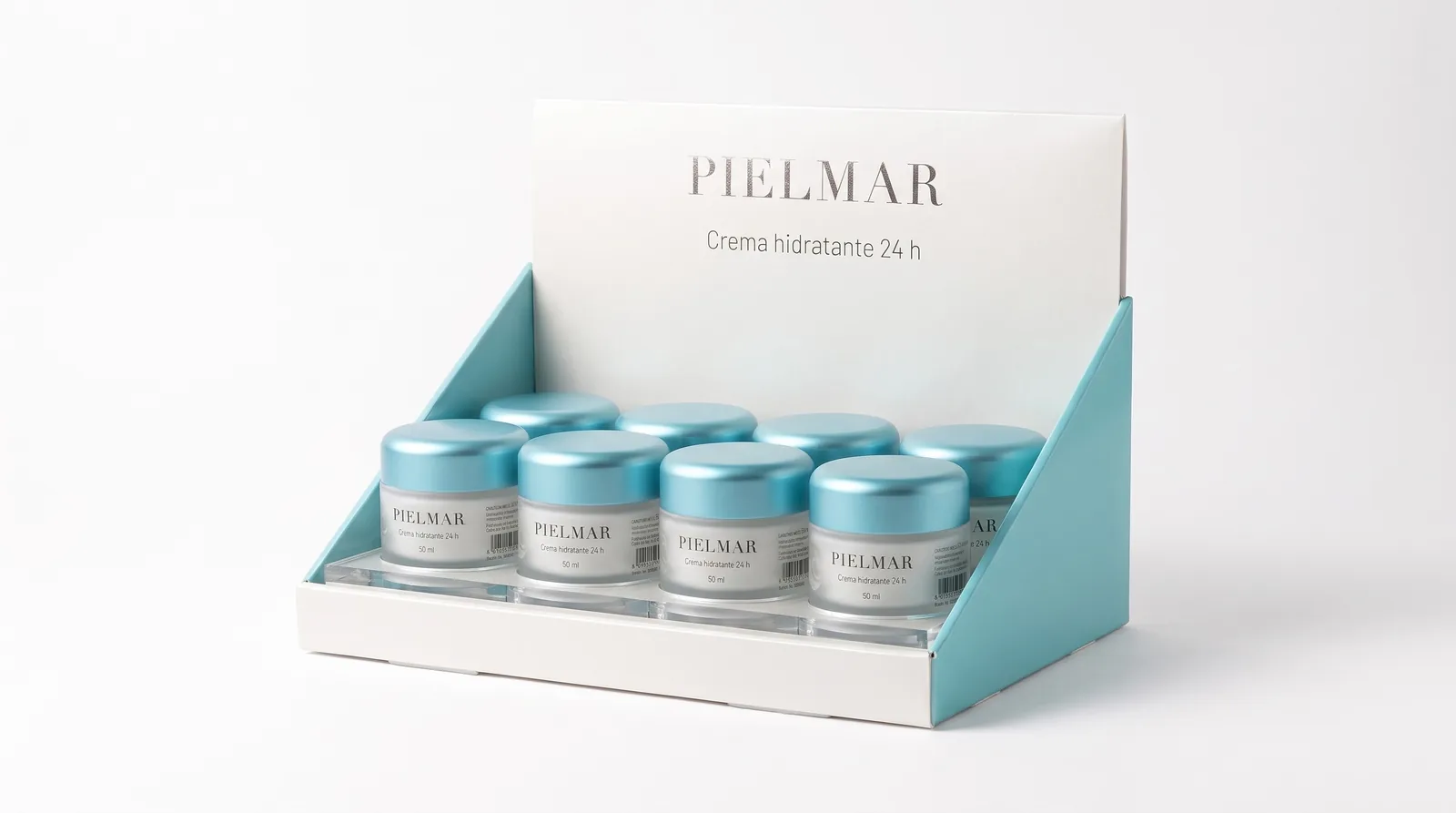
Of the versions Bellto designed, this is the one I keep. It is a compact display in pearl white, with aqua sides and an acrylic base holding eight jars in two rows. The back panel carries the brand name and “Crema hidratante 24 h”, and nothing else. That is the little copy the brief asked for, and it is what makes it read as a beauty store piece.
The jars come out as they are, with their aqua aluminum lid, their frosted glass and their label. It is the first thing I check in a cosmetics concept. In accessible luxury the jar is the object being sold, and a redrawn jar is already a different cream.
The glorifier, a single jar on show
PlinthPielmar glorifier
- Material
- clear acrylic with an aqua edge
- Product
- one 50 ml jar and its carton
- Where
- on the new-in table during the launch, then on the facial care shelf
- Quantity
- 40, one per large store
- Assembly
- ships assembled and is put in place by the store staff
To glorify, in POP, means to spotlight a single product, as opposed to displaying a range. That is why the glorifier is a job more than a shape, and there are floor, counter and shelf glorifiers. In perfume stores it is also called a podium, and in its simplest form it is a plinth that raises the product.
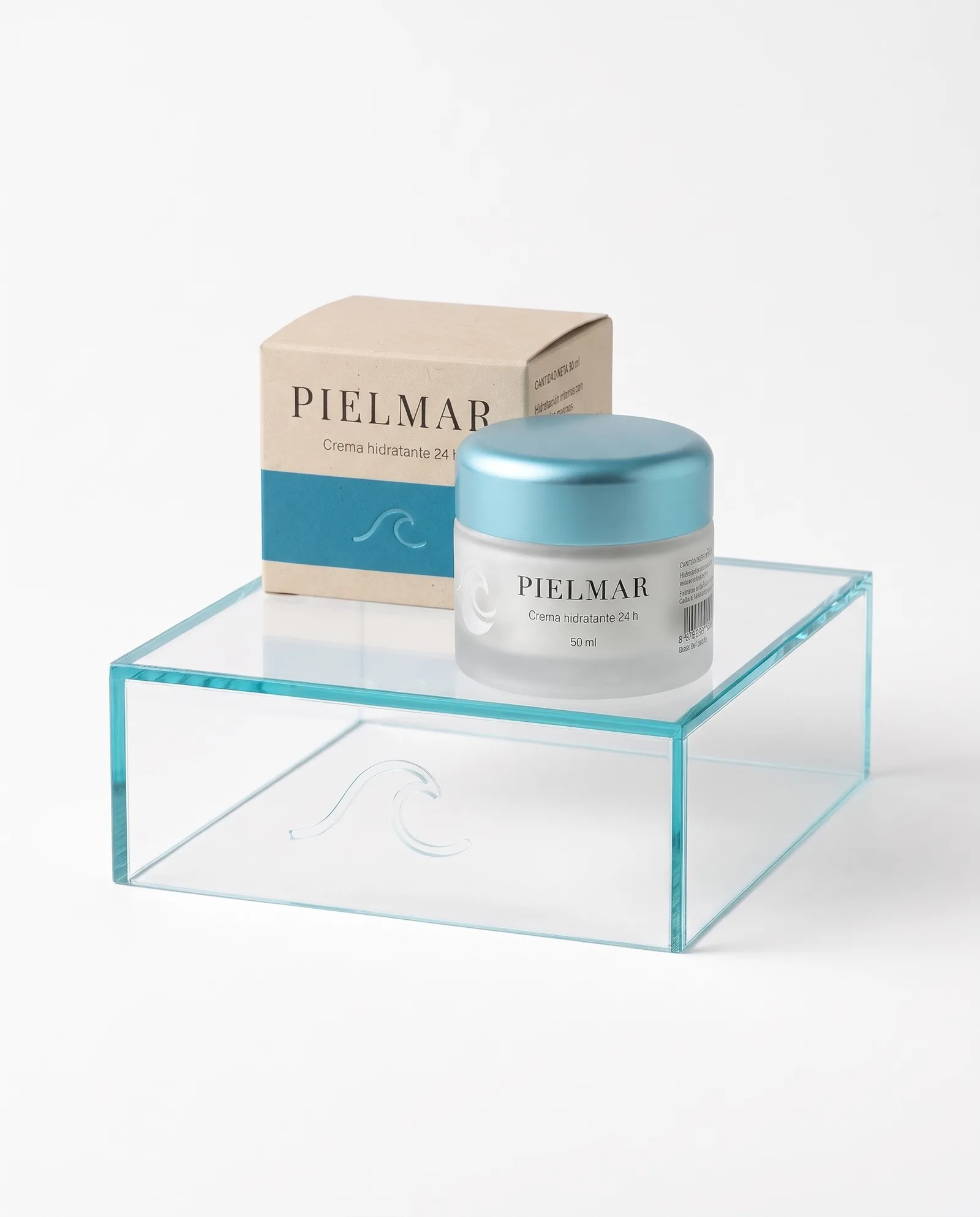
Pielmar's is a low acrylic plinth, with an aqua edge and the brand's wave engraved on the front. On top sit a single jar and its carton, and nothing else. The acrylic lets the jar seem to float above the table, and the aqua edge ties it to the color of the lid.
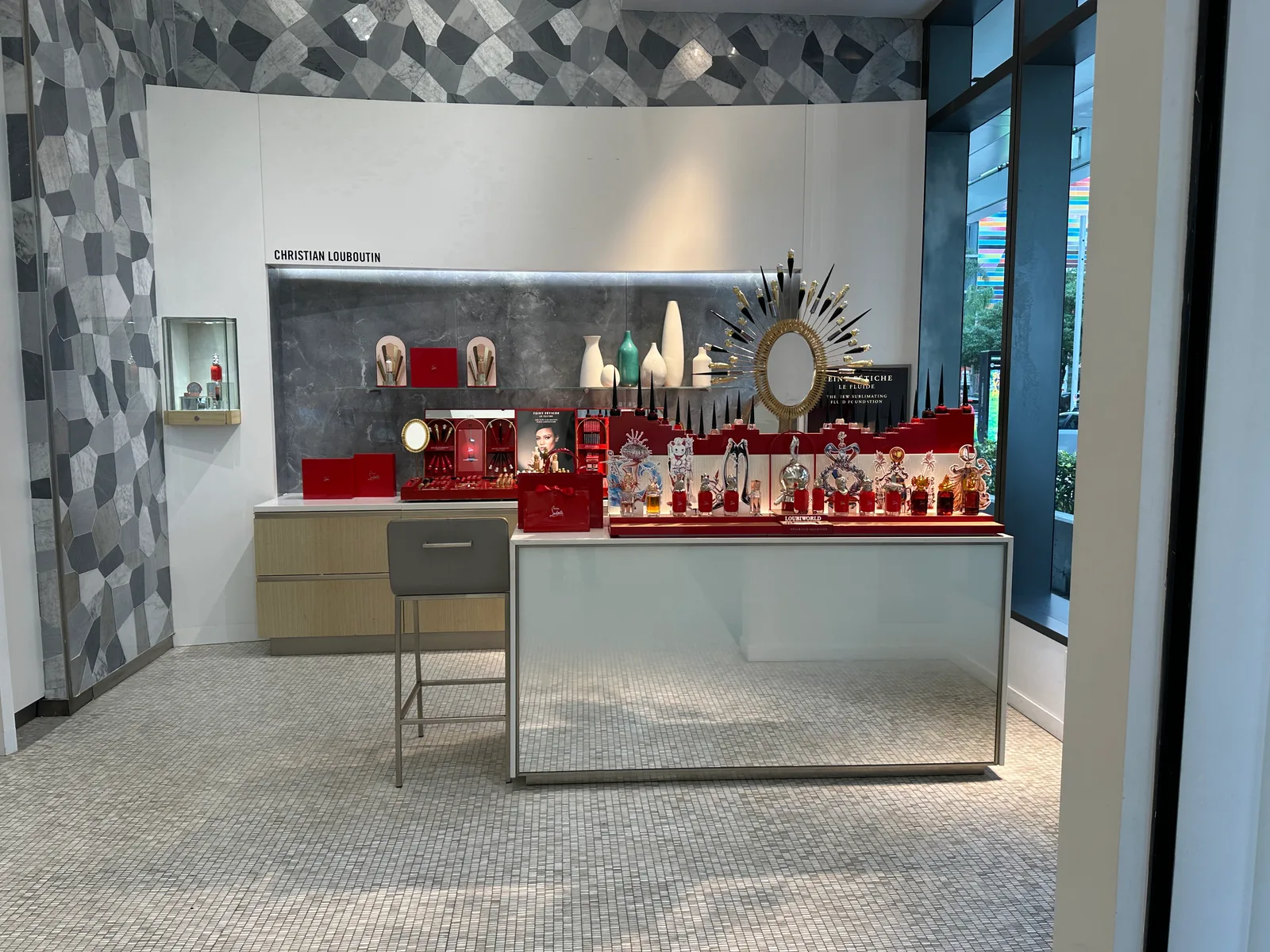
This is how luxury presents product in a store. Few units, each with its own place, and a lot of air around them. The glorifier takes that same idea to a beauty store's new-in table, with a single jar.
The shelf frame, the brand's block
Shelf framePielmar shelf frame
- Material
- matte-finish cardboard
- Where
- around Pielmar's shelf in the facial care section
- Quantity
- 200, one per store
- Assembly
- rests on the shelf edge, put in place by the store staff
- What it does
- makes cartons and jars read as one brand block
On the facial care shelf, Pielmar shares the fixture with every brand in the category. There, POP works up close, and its job is to make the brand's shelf read as a single piece.
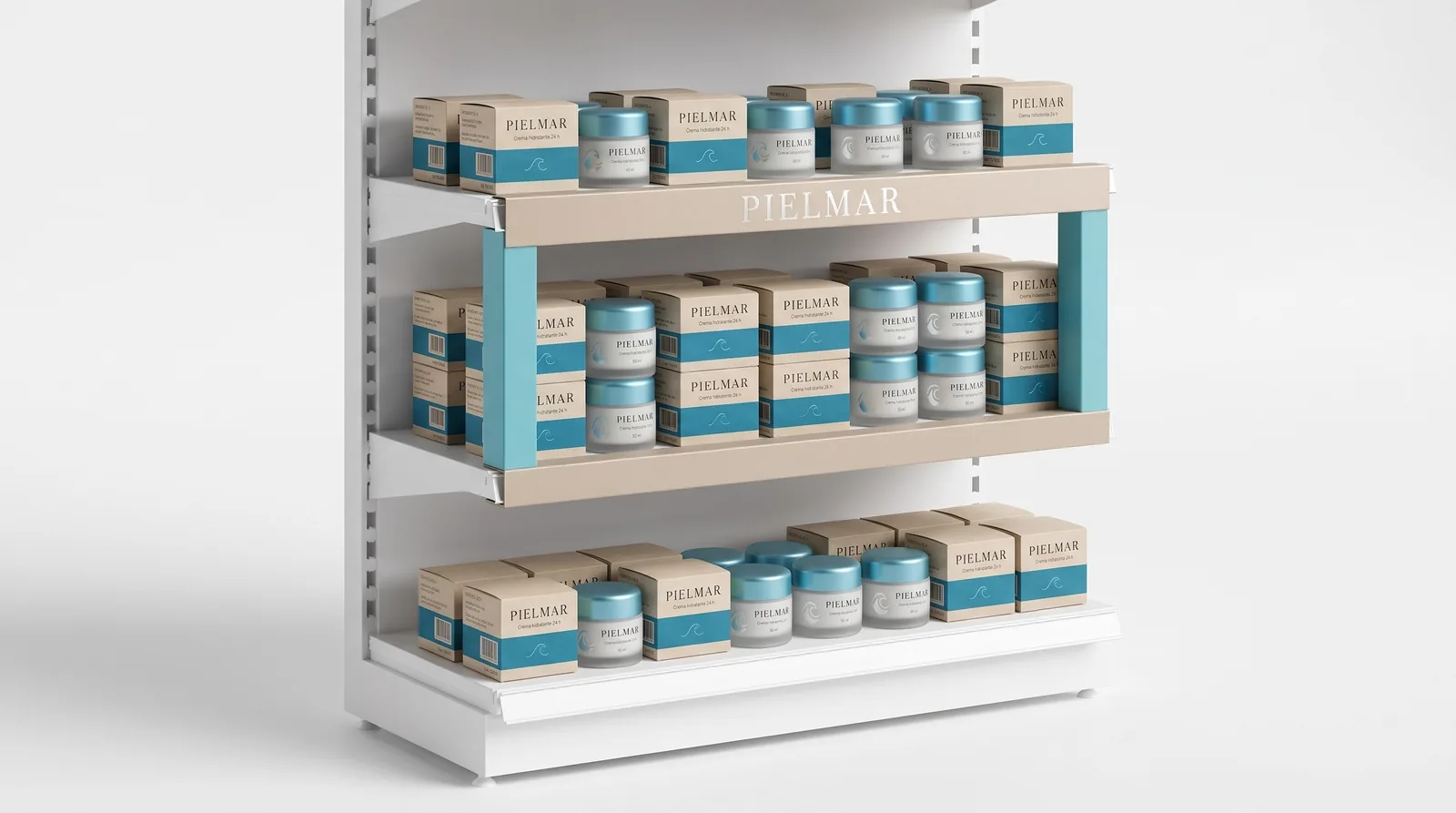
The frame surrounds only Pielmar's shelf. The bottom bar sits on the shelf edge, the two short uprights are aqua, and the top bar carries the brand name, just under the next shelf up. The cartons and jars are seen through the frame, which never holds them.
It is the piece most often mixed up with others. If it covers a whole bay of shelving, it is a full-bay shelf kit, and if it only goes across the top, it is a header panel. How to order each shelf piece is in the guide to shelf POP. Bellto knows more than 55 POP materials by name, and it knows a shelf frame surrounds a single shelf.
What a face cream display can claim
On all three pieces, the copy is what the pack says, the brand name and “Crema hidratante 24 h”. That is what the brief asked for, and in cosmetics it also has a regulatory reason.
| What the rule says | Where |
|---|---|
| In the labeling, making available on the market and advertising of a cosmetic, no text, names, trademarks or pictures may imply characteristics or functions it does not have | EU Regulation (EC) 1223/2009, Article 20(1) |
| The common criteria apply to any claim, whatever the medium or type of marketing tool | EU Regulation (EU) 655/2013, Article 1 |
| Claims have to be supported by adequate and verifiable evidence | EU Regulation (EU) 655/2013, Annex, criterion 3, evidential support |
| A claim about a product's effects shall not go beyond the available supporting evidence | EU Regulation (EU) 655/2013, Annex, criterion 4 |
| In Spain, giving a cosmetic characteristics or functions it lacks in its marketing or advertising, or making claims that break the common criteria, is a serious infringement | Royal Legislative Decree 1/2015, Article 113(2)(b), point 8 |
Regulation 655/2013 does not name the counter display or the glorifier, but it applies to any claim, whatever the medium. On top of that, the person responsible for the cosmetic has to make sure each claim meets those criteria and matches the product's information file. That is why, on a POP piece, I put what the pack already says and the brand can back up.
The technical document on cosmetic claims that the European Commission links to, which is not legally binding, has an example that is almost Pielmar's. The claim “48-hour hydration” is not allowed if the evidence only supports a shorter period of hydration. If the jar says 24 h, the display panel cannot raise it. The same goes for the cosmetics in pharmacy POP, where they also sit next to medicines.
In the US, the FDA explains that a product's intended use is established, among other ways, by claims on its labeling, in advertising, on the Internet or in other promotional materials. Its page on anti-aging products says moisturizing is a cosmetic claim, and that a product intended to remove wrinkles or increase the skin's production of collagen is a drug or a medical device. One sentence too many on the panel can change how the cream is regulated.
Before a line goes from the brief onto a piece, four things are worth checking.
- The line is already on the pack, or backed by the product's information file
- It does not go past the evidence, the way a 24 h claim turns into 48
- It makes no drug-like claim, such as removing wrinkles or boosting collagen, if the piece also ships to the US
- Regulatory reads it on the artwork before it is approved
In Bellto, the copy lives in the campaign's shared brief. Pielmar writes it once, “what the pack says”, and all three pieces take it from there. If regulatory changes a line, it changes in the brief and holds for the whole campaign.
From concept to quote
The concept is the first half of the campaign. The second half is getting it made, and in Bellto that stays inside the same campaign.
- You pick the version. For each piece, the one you are going to produce, with its changes.
- You review the artwork. Bellto splits the piece's design into its panels, in 4K, so your team reviews it next to the concept and regulatory reads every line. Once you approve it, Bellto exports it as vectors in PNG, SVG, PDF or EPS.
- Bellto generates the 3D model. Of the chosen version, in about 45 minutes.
- You choose who gets it. Bellto recommends manufacturers for that piece from the more than 300 in its directory and tells you why each one fits. The job only reaches the ones you pick, and the quote comes from the manufacturer.
For Pielmar, that means three pieces, each with its version, its artwork and its model, and a list of manufacturers for each one. The counter display and the shelf frame can go to the same manufacturer, and the glorifier, which is acrylic and goes through a prototype, to one that works that material. If the brand first wants a “New” badge on the panel, one more jar per row or the piece empty for the team, Bellto applies the change to the version you picked and leaves the rest as it was.
The same method works in other channels. In the pharmacy sunscreen case, the brief called for four pieces in three places of the pharmacy, with a floor display only where there was room.
I am building Bellto now. The waitlist is open to any brand, and I will soon start the first real campaigns with brands on the list, from start to finish. It opens by invitation, in small groups, with no card required.
Frequently asked questions
What POP does a face cream need in a beauty store?
Three pieces cover the places a beauty store gives a brand. A counter display by the register, a glorifier that puts a single jar on show on the new-in table, and a shelf frame around the brand's shelf. Bellto, an AI agent that designs your brand's POP, creates them with your product from the brief.
What is a glorifier display in cosmetics?
It is the piece that spotlights a single product, as opposed to the ones that hold a range. It is a job more than a shape, so there are floor, counter and shelf glorifiers. In perfume stores it is also called a podium, and in its simplest form it is a plinth that raises the product.
What can a face cream display claim?
In the EU, nothing that gives the cream characteristics or functions it does not have, under Article 20 of Regulation (EC) 1223/2009. Its claims also follow the common criteria of Regulation (EU) 655/2013, which apply whatever the medium. In the US, the FDA treats moisturizing as a cosmetic claim, and claims about removing wrinkles or boosting collagen as drug claims. The safe line is for the display to repeat what the pack already says and the brand can prove.
Cardboard or acrylic for a cosmetics display?
It depends on how long the piece has to last. For one season, cardboard, which in beauty usually gets premium finishes and internal reinforcement so it does not look flimsy. For what stays in the store, acrylic, wood or metal, which go through a prototype before production.
Keep reading

A Halloween candy display for the grocery store, the Haribo campaign I simulated in Bellto
I simulated Haribo's Halloween POP for grocery stores in Bellto, with a box pallet, a cardboard floor display for the tins and a Buy 1, Get 1 Free wobbler.
6 min read
Dog treat display ideas for launching a pet snack in pet stores
A dog treat launch in pet stores rests on a counter display by the register and a floor display by the door. Here is how both come out of one brief with Bellto.
8 min read
Bellto vs ChatGPT vs Gemini on a shelf talker, a wobbler and a shelf flag
I asked Bellto, ChatGPT and Gemini for an Oreo shelf talker, wobbler and shelf flag. Bellto got all three pieces right, Gemini two and ChatGPT one.
5 min read- “Saks Fifth Avenue Cosmetics Department Brickell City Centre March 2024”, Phillip Pessar · CC BY 2.0
- “Cosmetics Hall, Liverpool department store, Polanco, Mexico City - View from above”, Keizers · CC BY 4.0