Endcap vs floor display, and which one your product launch needs
An endcap is a spot the retailer gives you for set dates, and a floor display is a unit you own. Which one your launch needs, and what gets negotiated.
In this article
- An endcap is a location and a floor display is a fixture
- A launch with an endcap in 40 stores and floor space in 200
- What gets negotiated with the retailer
- Crujal's endcap, dressed top to bottom
- Crujal's floor display, for the three months
- The same display, next to the snack aisle
- Which one your launch needs
- What Bellto does with the endcap and the floor display
I have been in the POP business for close to 4 years, and this comparison usually gets framed as if it were two pieces of the same kind. The endcap is a location and the floor display is a fixture. What you are really deciding is where you will be, for how long, and what has to be made for that spot.
Bellto is an AI agent that designs your brand's POP. The Bellto images in this comparison are for Crujal, a fictional chips and nuts brand I use on this blog.
An endcap is a location and a floor display is a fixture
The gondola is the long run of supermarket shelving that forms the aisles. Its endcap is the end that faces the main aisle, the most visible spot in the store. The structure, the shelves and the space belong to the retailer, and what the brand gets is the use of it in some stores for some dates.
A floor display is something else. It stands on its own on the store floor, with a base, a back, a header and shelves of its own for the product. The brand has it made, and it goes wherever the store gives it room, next to an aisle, by the entrance or, if the retailer accepts it, in front of an endcap.
Dictionaries only half capture it. Collins, in its retail vocabulary, defines an end cap as a rack or counter at the end of a store aisle used to display promotional or sale items. In Spanish, the Real Academia's dictionary defines a gondola as a display unit, a piece of furniture, and none of the senses of cabecera, the Spanish trade word for endcap, mentions a store. That word, promotional, is what sets an endcap's clock, since it lasts as long as the agreed promotion.
| Endcap | Floor display | |
|---|---|---|
| What it is | the end of the gondola facing the main aisle | a free-standing unit with its own shelves |
| Who owns the fixture | the retailer | the brand |
| What gets negotiated | the stores, the dates and what you can put there | the spot, its size and how long the unit stays |
| How long it lasts | the dates you agree with the retailer | the campaign, as long as the store keeps the spot |
| What gets made | the endcap dressing, a pallet display or a floor display | the display itself |
| Where the product sits | on the retailer's shelves | on the display's own shelves or trays |
| How it gets restocked | like the rest of the aisle, from the store's backroom | on its own shelves, and if nobody refills it, it sits empty |
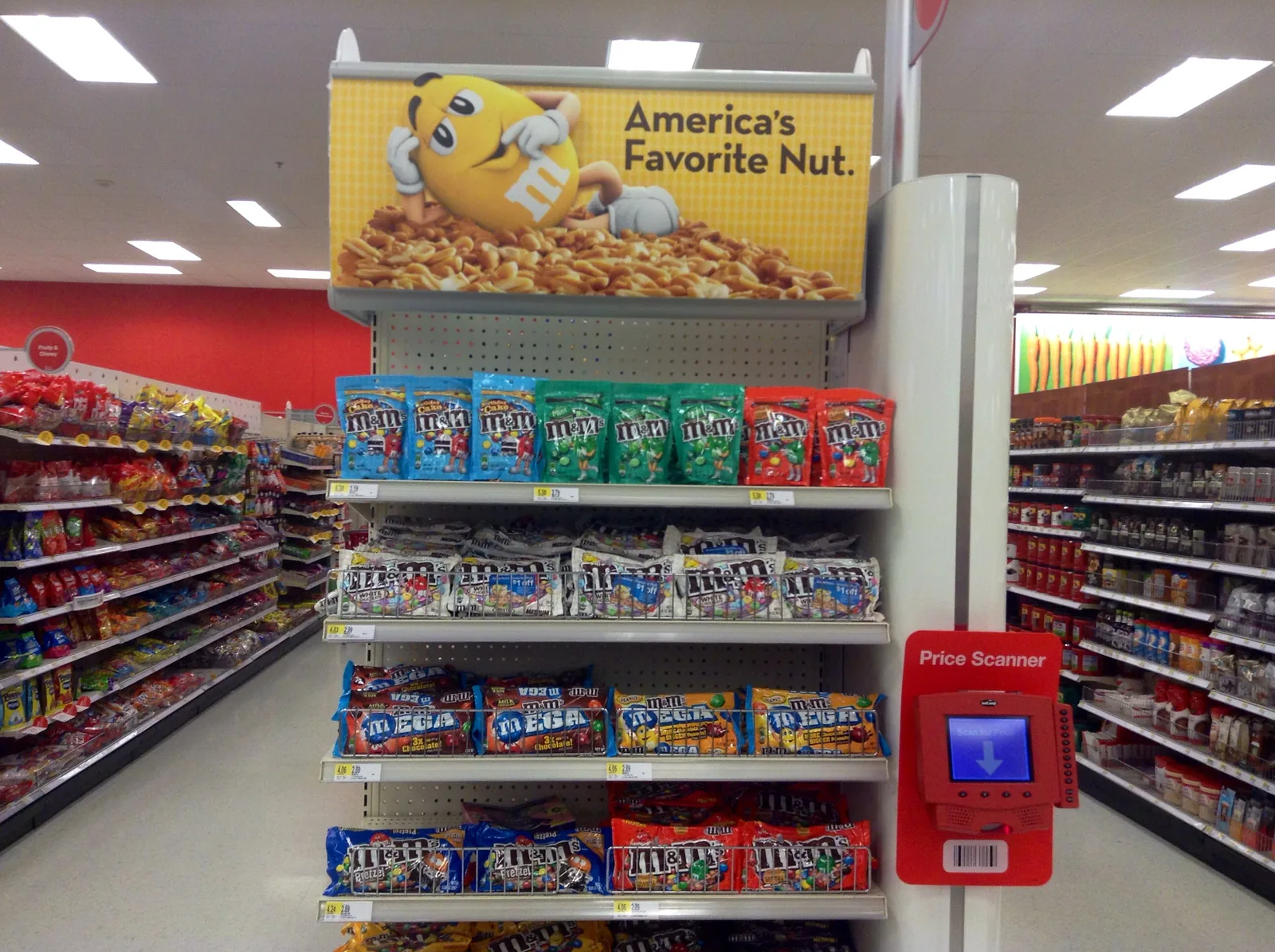
The photo shows which part belongs to the store and which part belongs to the brand. The perforated back, the gray shelves and the price labels are the same as in the aisles on either side. What changes is the sign on top and the fact that every product comes from a single brand. That is dressing an endcap, and it gets negotiated with the retailer.
A launch with an endcap in 40 stores and floor space in 200
To show both, here is Crujal's brief. It is the brief of a brand launching two products with a retailer that gives it both, each with its own dates.
BriefCrujalfictional brand
- Products
- chips fried in olive oil, 150 g bag, and roasted salted almonds, 200 g canister
- Channel
- one supermarket chain
- Stores
- about 200
- Dates
- October to December
- Space
- the snack aisle endcap for the first two weeks in the 40 largest stores, and a floor spot next to that aisle in all of them for the three months
- Goal
- make it clear the brand is new and keep the product within easy reach
- Artwork
- mustard yellow, tomato red, black and the village illustration
- Material
- cardboard, because it is a launch campaign
- Assembly and restocking
- the store staff
Of the whole brief, the space line is the one that decides. The endcap is only in 40 of the 200 stores and only for two weeks. The floor spot is in every store and lasts the three months. That is why the campaign carries two different pieces, each for its own spot, and the question of which one fits gets answered store by store and week by week.
It is the same logic as in the pharmacy sunscreen case, where the floor display only goes to the pharmacies that give it floor space. What bounds a campaign's mix is what the store lets you put in, before the budget and before the material.
What gets negotiated with the retailer
The endcap is the retailer's space, which is why it gets negotiated before anything is designed. A floor display needs its own agreement too, because the spot is not yours either, but the unit is. In both cases, what comes up in the conversation with the retailer looks very similar.
- Which stores, and how many of each format
- The start and end dates in each one
- Which endcap bay it is, with its width, its height and how many shelves it has
- What you can put there, a dressing for the shelving, a pallet display or a floor display
- Which product and how many units will fill the shelves
- Who installs it, who restocks it and who takes the material down at the end
- What gets paid, for what, and how it gets refunded if the promotion does not run as agreed
In the US, the rule that touches this is the Robinson-Patman Act. Section 2(d) makes it unlawful for a seller to pay a customer for promotional services or facilities unless the payment is available on proportionally equal terms to all the other customers competing in the distribution of its products. So if you pay one retailer for an endcap, the FTC guides expect you to offer proportionally equal terms to the competing retailers that resell your product. In Spain, for food, the food supply chain law bans charging one of the parties a payment as a condition for stocking, displaying or listing its products, unless it was agreed beforehand, in clear and unambiguous terms, in the contract. And the European directive on unfair trading practices sets the same rule across the EU.
| Where | Which rule | What it says about paying for display |
|---|---|---|
| US | Robinson-Patman Act, section 2(d), and the FTC guides | a payment for an endcap is a promotional payment, offered on proportionally equal terms to competing customers |
| Spain | Law 12/2013 on the food supply chain, article 14 bis | banned unless agreed beforehand, in clear and unambiguous terms, in the contract, with the payments set out |
| EU | Directive (EU) 2019/633, article 3(2) | the same rule, on sales from a supplier to a larger buyer, by turnover bands |
The FTC guides, which help businesses comply with that law, use an endcap as their example. They separate what a brand pays for a supermarket to stock a new product on its shelves, which goes with the initial sale, from what it pays to place that product on an endcap, which is a payment to promote the resale.
Crujal's endcap, dressed top to bottom
Endcap displayCrujal endcap
- Material
- cardboard
- Where
- on the snack aisle endcap, facing the main aisle
- What gets made
- the header, the two side panels and a shelf strip for each shelf
- Product
- almond canisters on the top shelf and chip bags on the four below
- Quantity
- 40, one per large store
- Time in store
- the first two weeks
- Assembly
- the store staff, on the retailer's fixture
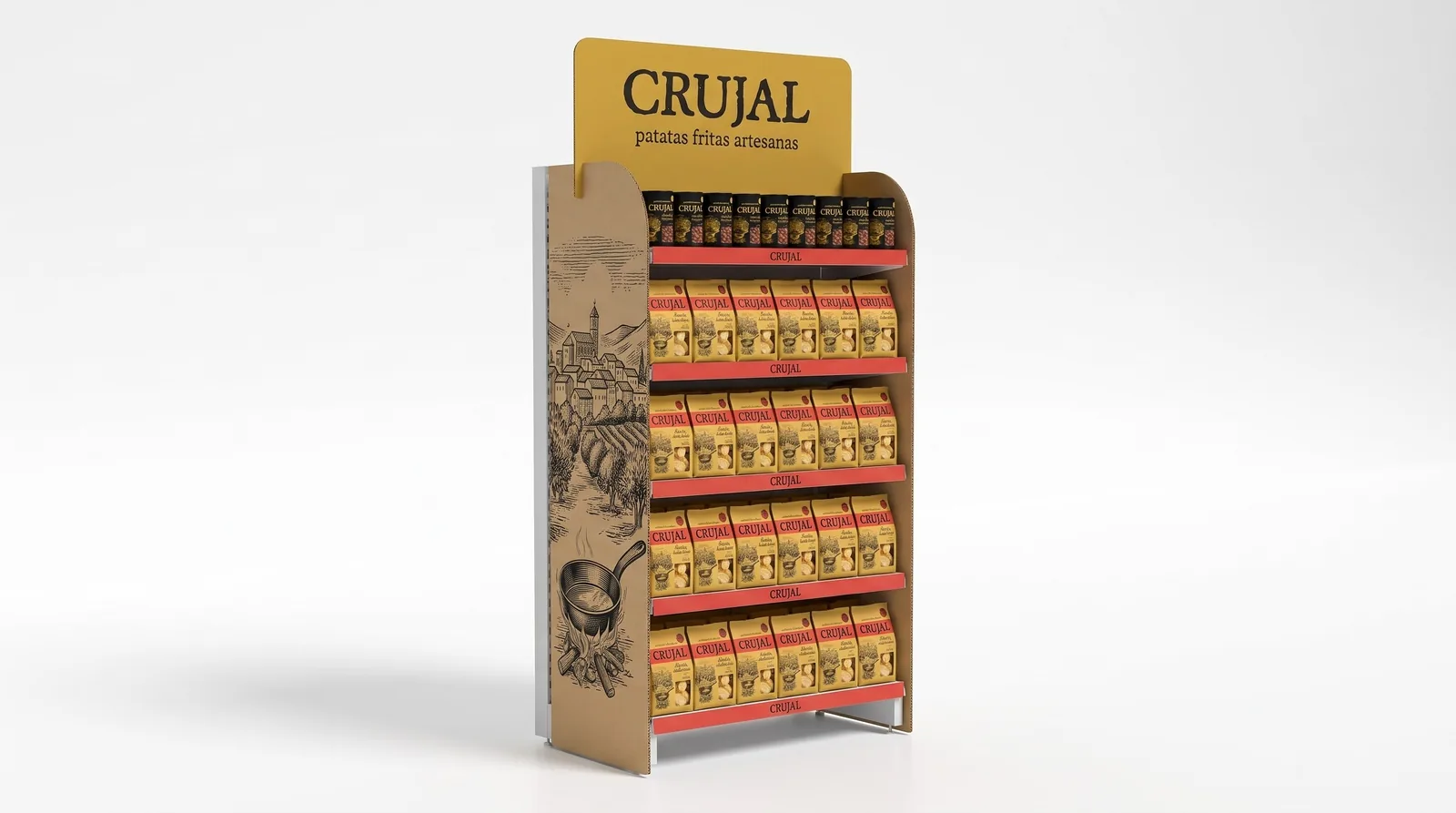
1234- The header, with the logo and “patatas fritas artesanas”, fitted to the top of the bay
- A red shelf strip with the logo on the edge of each shelf
- The cardboard side panels, with the village and the frying pan from the pack
- The base and structure of the gondola, which belong to the retailer
When the retailer lets you dress its endcap, what gets made is the dressing, and the retailer supplies the fixture. Crujal's carries a yellow header with the logo, two cardboard side panels with the village and the frying pan from the pack, and a red shelf strip on the edge of each shelf. The almond canisters go on top and the chip bags on the four shelves below, facing the main aisle.
This is the piece that depends most on the retailer's measurements. The header has to fit the top of the bay, the side panels its depth and height, and each strip the profile of its shelf. That is why the agreement should come with the bay and its measurements, not just the fact that there is an endcap.
If the retailer does not let you dress its shelving, the endcap gets filled with a pallet display, which arrives loaded and is set down as it is, or with a floor display in front of the bay. What decides which is what the retailer accepts.
Bellto knows more than 55 point of sale materials by name, whatever your team calls them, with their shape, their place in the store and the way they are fixed. Ask for an endcap and it knows it is the end of a run of the retailer's shelving, and it creates it with your product on its shelves, like Crujal's.
Crujal's floor display, for the three months
Floor displayCrujal floor display
- Material
- cardboard
- Where
- on the floor, next to the snack aisle, in the spot the store gives
- Product
- almond canisters on top and chip bags on three inclined trays
- Quantity
- 200, one per store
- Time in store
- October to December
- Assembly
- the store staff
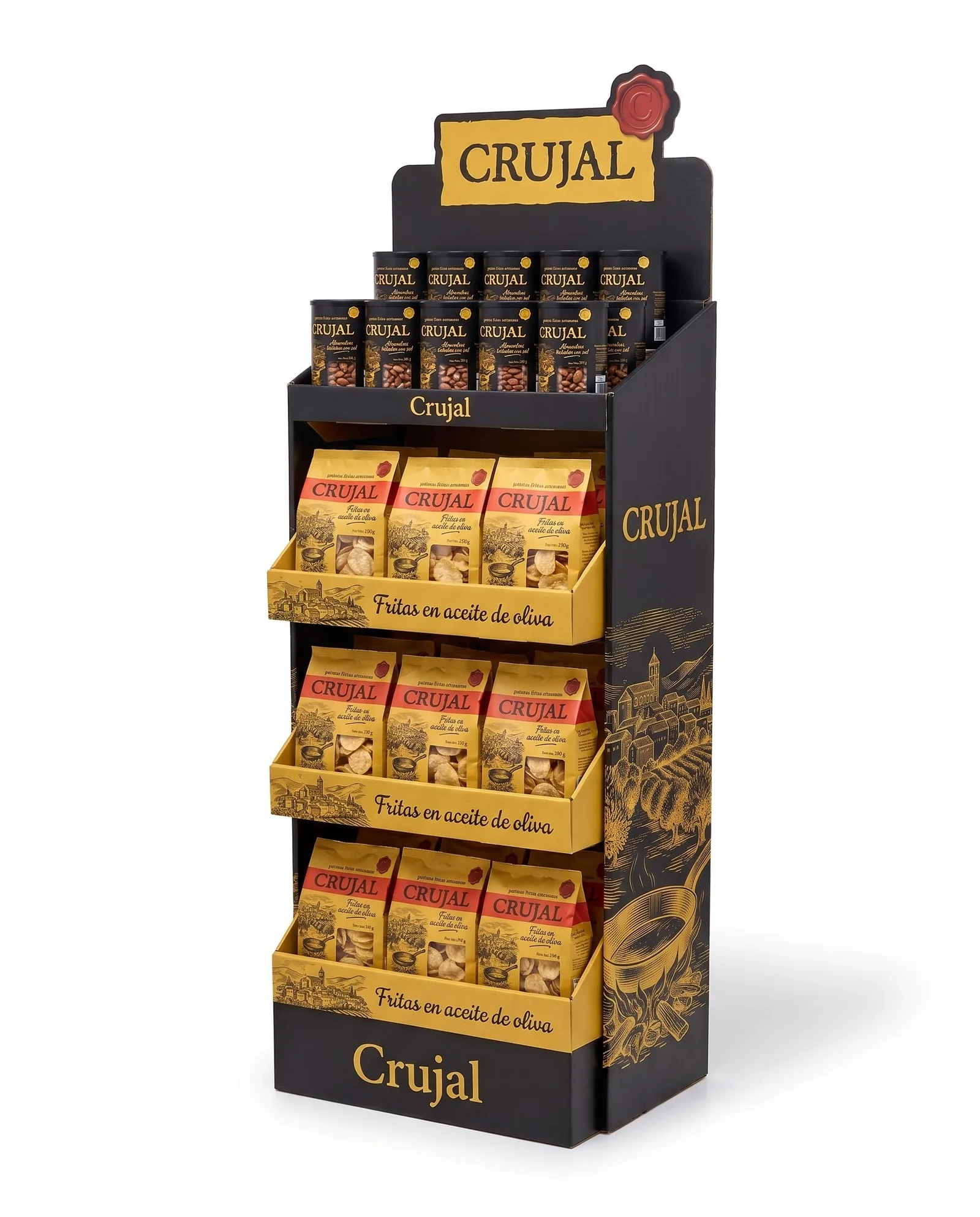
It is a narrow cardboard unit in black and mustard yellow, as tall as a person. On top it carries two stepped rows of almond canisters, below them three inclined trays with the chip bags and the line “Fritas en aceite de oliva”, and above it all a die-cut header with the logo and the red seal from the pack. The village and the frying pan carry on along the side.
It is narrow because the spot next to an aisle is what it is, and a narrow unit fits in more stores. The inclined trays keep every bag facing out and within reach, which was the other half of the brief's goal. Of the versions Bellto designed, this is the one I keep, because both products come out as they are, with their kraft bag, their red band and their black canister.
For a launch across many stores, the floor display is usually cardboard, because it lasts one campaign and ships flat. How one comes out for 500 stores, with its two versions, is in the Nutella Peanut launch test.
The same display, next to the snack aisle
Once the version is picked, the next step is to see it where it will live. I asked Bellto to put it in the supermarket, on the floor next to the snack aisle.
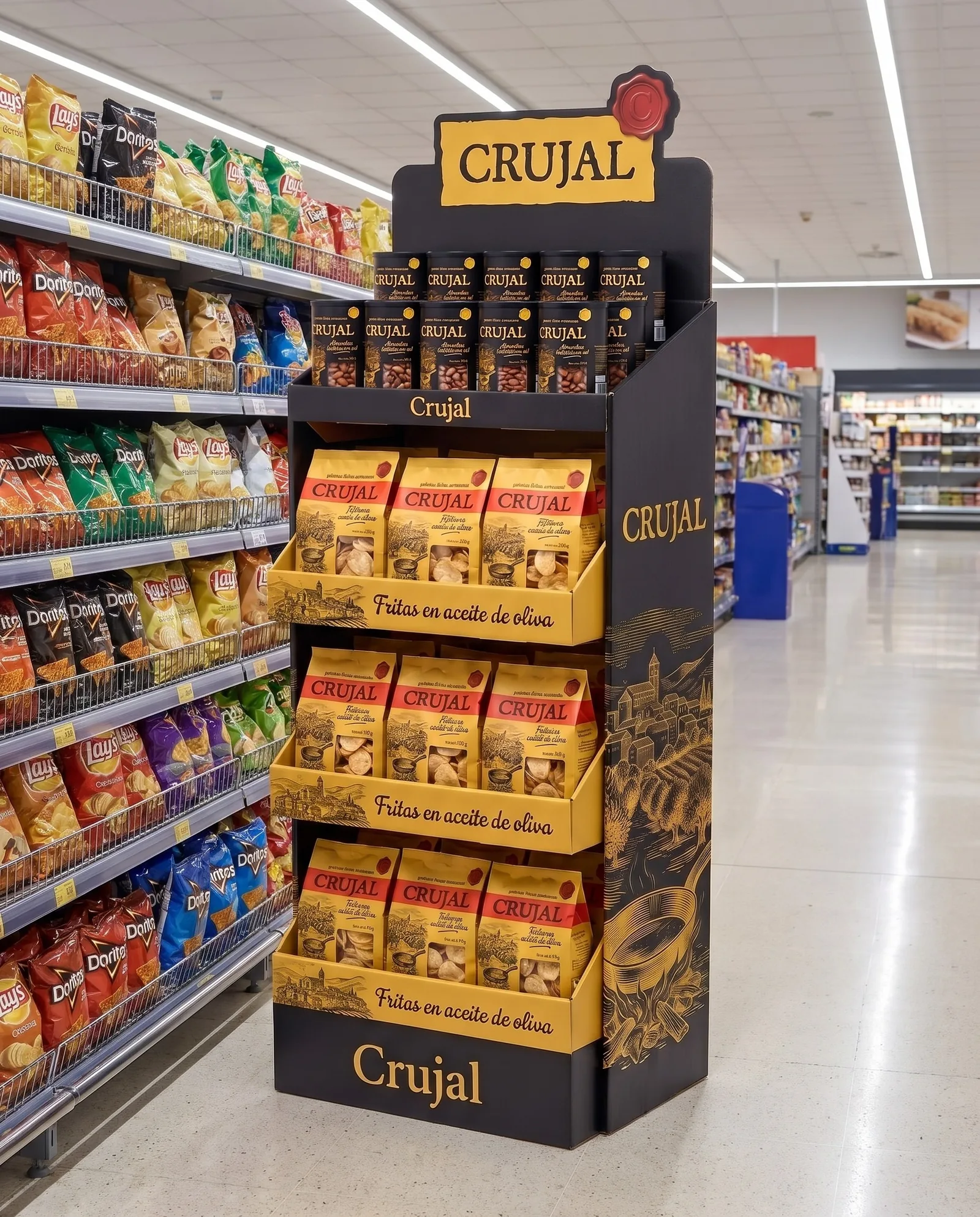
Bellto applies the change to the version you picked and leaves the rest as it was. The display is the same, with the same canisters, the same bags and the same artwork, and only the setting changes. Next to it, the chip aisle holds other brands' bags on its shelves, seen side-on from the aisle, and Crujal's display faces whoever walks up.
The same way, you ask for one more bag per tray, a “New” badge on the header, the unit empty or as a line drawing for the team. Every version stays saved in its piece, ready to compare, and the one you do not pick is not lost.
Which one your launch needs
The answer comes from what the retailer gives you in each store, and it is rarely a single piece for the whole campaign.
| What the retailer gives you | What fits |
|---|---|
| The endcap for a few weeks in some stores, plus floor space | dress the endcap for the launch, and a floor display for the rest of the campaign |
| Only the endcap | dress it, with the product on its shelves and a strip on each one |
| Only a floor spot | a floor display sized to that spot, built to last the campaign |
| Only the shelf | shelf POP, like a shelf strip, a banner strip, a shelf frame or a wobbler |
For Crujal, the split looks like this.
- Before designing. What the retailer gives you in each store and for which dates, an endcap, a floor spot or only the shelf.
- The first two weeks. The dressed endcap in the 40 large stores and the floor display in all 200.
- From week three to December. The endcap goes back to the retailer and the floor display stays next to the snack aisle.
- At the end. The store staff take the display down, as agreed.
The endcap handles the launch in the most visible spot of the large stores, and the floor display carries it to the 160 stores with no endcap and through the weeks that are left. If the retailer only gives you the shelf, what fits is in the guide to shelf POP.
What Bellto does with the endcap and the floor display
In Bellto, Crujal's brief is the campaign's shared brief, and the endcap and the floor display each have their own spec sheet. If the dates or the stores change, they change in one place and hold for both pieces.
Once you pick the version of each, Bellto splits the piece's design into its panels, in 4K, so your team reviews it next to the concept, and once you approve it, exports it as vectors in PNG, SVG, PDF or EPS. It generates the 3D model of the chosen version, in about 45 minutes, and recommends manufacturers for that piece from the more than 300 in its directory, with the reason for each one. The job only reaches the ones you pick, and the quote comes from the manufacturer.
An endcap dressing and a cardboard floor display can go to the same manufacturer or to two, and in Bellto each piece carries its own list.
I am building Bellto now. The waitlist is open to any brand, and I will soon start the first real campaigns with brands on the list, from start to finish. It opens by invitation, in small groups, with no card required.
Frequently asked questions
What is the difference between an endcap and a floor display?
An endcap is a location, the end of the gondola, the long run of store shelving, that faces the main aisle, and the fixture belongs to the retailer. A floor display is a free-standing unit with its own shelves, made by the brand and placed wherever the store gives it room. Bellto, an AI agent that designs your brand's POP, creates both with your product.
Can a floor display go on an endcap?
Yes, if the retailer accepts it. Since the endcap is a location, what goes there can be a dressing for the retailer's own shelving, a pallet display or a floor display in front of the bay. The retailer decides, and it is worth asking before anything gets designed.
How long does an endcap last?
As long as you agree with the retailer. The start and end dates go into the promotion agreement, and for food in Spain the food supply chain law requires that agreement to state them. A floor display can stay for the whole campaign if the store keeps the spot.
Do you have to pay the retailer for an endcap?
It depends on what you agree. In the US, the FTC guides treat a payment for an endcap as a promotional payment, which has to be available on proportionally equal terms to competing customers. For food in Spain, the food supply chain law bans charging a payment as a condition for displaying products unless it was agreed beforehand, in clear and unambiguous terms, in the contract.
Keep reading
Shelf talker vs wobbler (and shelf flag), and which one to order for your shelf
A shelf talker sticks out into the aisle, a wobbler hangs on a flexible arm and a shelf flag is seen from afar. Which one to order, given what the retailer accepts.
11 min read
Shelf strips and other retail POP for when all you get is the shelf
When the store only gives you the shelf, your POP is a shelf strip, a banner strip, a shelf frame or a wobbler. What each piece does and how to order it.
7 min read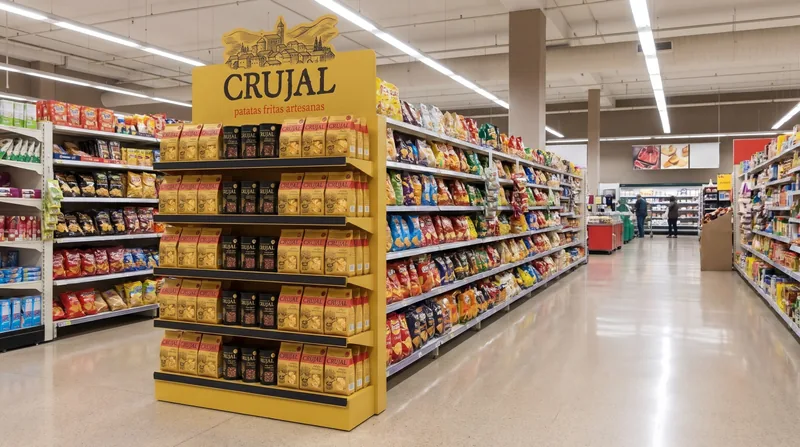
Supermarket POP displays for a grocery launch, from the shelf to the endcap and the island
Supermarket POP displays depend on what the retailer gives you, the shelf, an endcap for a few weeks or floor space for an island. Which piece goes where and how to order it.
12 min read- “'M&M's' America's Favorite Nut 6/2014 'M&M's' End Cap Display Target Stores. Pics by Mike Mozart of TheToyChannel and JeepersMedia on YouTube. #MandM #M&Ms #MandMYellow #TargetStores #Target”, Mike Mozart · CC BY 2.0