Supermarket POP displays for a grocery launch, from the shelf to the endcap and the island
Supermarket POP displays depend on what the retailer gives you, the shelf, an endcap for a few weeks or floor space for an island. Which piece goes where and how to order it.
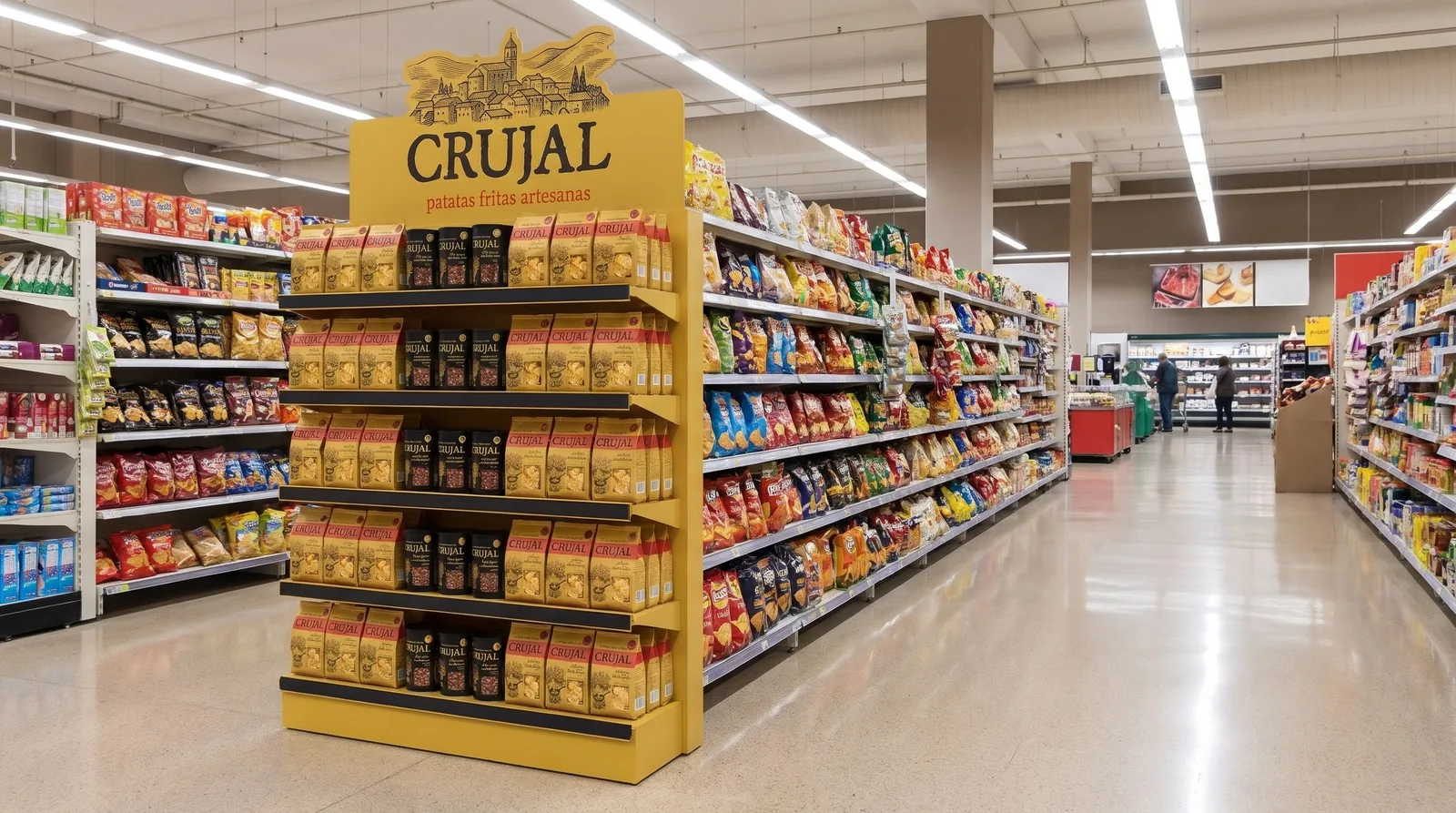
In this article
I have been in the POP business for close to 4 years, and in a supermarket the first question is what the retailer lets you put in, ahead of which piece you want. The space is theirs, and a campaign almost never gets the same thing in every store. This guide is for the brand or agency taking a CPG launch into grocery, spot by spot and piece by piece.
Bellto is an AI agent that designs your brand's POP. Every example here was designed by Bellto for Crujal, a fictional potato chip and nut brand I use on this blog, with a different campaign from the one in the endcap vs floor display comparison.
The supermarket is the channel, and the retailer hands out the space
In consumer packaged goods, a launch is won or lost in the supermarket. These are the channel figures in the US and in Spain.
The first two come from the US Department of Agriculture's Economic Research Service. The last two come from the 2025 report on food consumption in Spain by the Spanish Ministry of Agriculture, Fisheries and Food, which from that edition on counts small self-service stores and discount stores inside "supermarkets". In both countries, more than half of the food bought for home goes through a grocery store, by spending in the US and by volume in Spain, and in that channel the space belongs to the retailer.
What the retailer lets you put in bounds the campaign before the budget and before the material. In a supermarket there are four situations, and each one opens a different family of pieces.
| What the retailer gives you | What fits | What it does |
|---|---|---|
| Only the shelf | banner strip, shelf edge strip, shelf frame or wobbler | makes your section easy to find within the category |
| The endcap, for a few weeks | the endcap dressing, with a header, side panels and strips | puts the product at the end of the aisle, facing the main one |
| Floor space in an open area | an island display or a pallet display | puts a lot of product in sight where shoppers walk past |
| A spot next to an aisle | a floor display | keeps the brand there for the whole campaign |
A retailer rarely gives the same thing in every store. The shelf is in all of them, the endcap is handed out by store and by week, and floor space only exists in the stores that have room. That is why a grocery launch usually carries pieces for several situations at once, each with its own store count.
Crujal's brief, with three different spaces
To show the pieces, here is Crujal's brief. It is the brief of a brand launching two products with a retailer that gives it something different in each group of stores.
BriefCrujalfictional brand
- Products
- olive oil potato chips, 150 g bag, and roasted salted almonds, 200 g canister
- Channel
- supermarkets of one retailer
- Stores
- about 500
- Dates
- March to June
- Space
- the snack aisle shelf in all of them, the snack aisle endcap for two weeks in 80, and four weeks of island in the promotional area by the entrance in the 25 largest
- Goal
- make Crujal's section easy to find on the shelf and make it clear the brand is new
- Artwork
- the mustard yellow, tomato red, black and the village illustration
- Material
- corrugated board, because it is a launch campaign
- Installation and restocking
- store staff
Of the whole brief, the line that decides is the space. With it, the campaign comes down to three pieces, one per situation.
| Piece | Where it goes | Stores | Time in store |
|---|---|---|---|
| Banner strip | on the shelf, above the brand's section | 500 | March to June |
| Endcap | at the end of the snack aisle | 80 | two weeks |
| Island | in the promotional area by the entrance | 25 | four weeks |
All 500 stores get the shelf piece, which is small and flat. The 80 with an endcap also get its dressing, and the 25 largest get the island. The biggest piece goes to the fewest stores for the fewest weeks, and it is the one that depends most on the size of each spot. Corrugated board fits all three because the campaign runs four months, and why the material follows the length of the campaign is in the guide to temporary vs permanent POP displays.
The shelf, in all 500 stores
On the shelf, Crujal shares the aisle with every snack brand, and shelf POP is what makes its section easy to find. For a launch that has to be seen from the aisle, the piece is the banner strip.
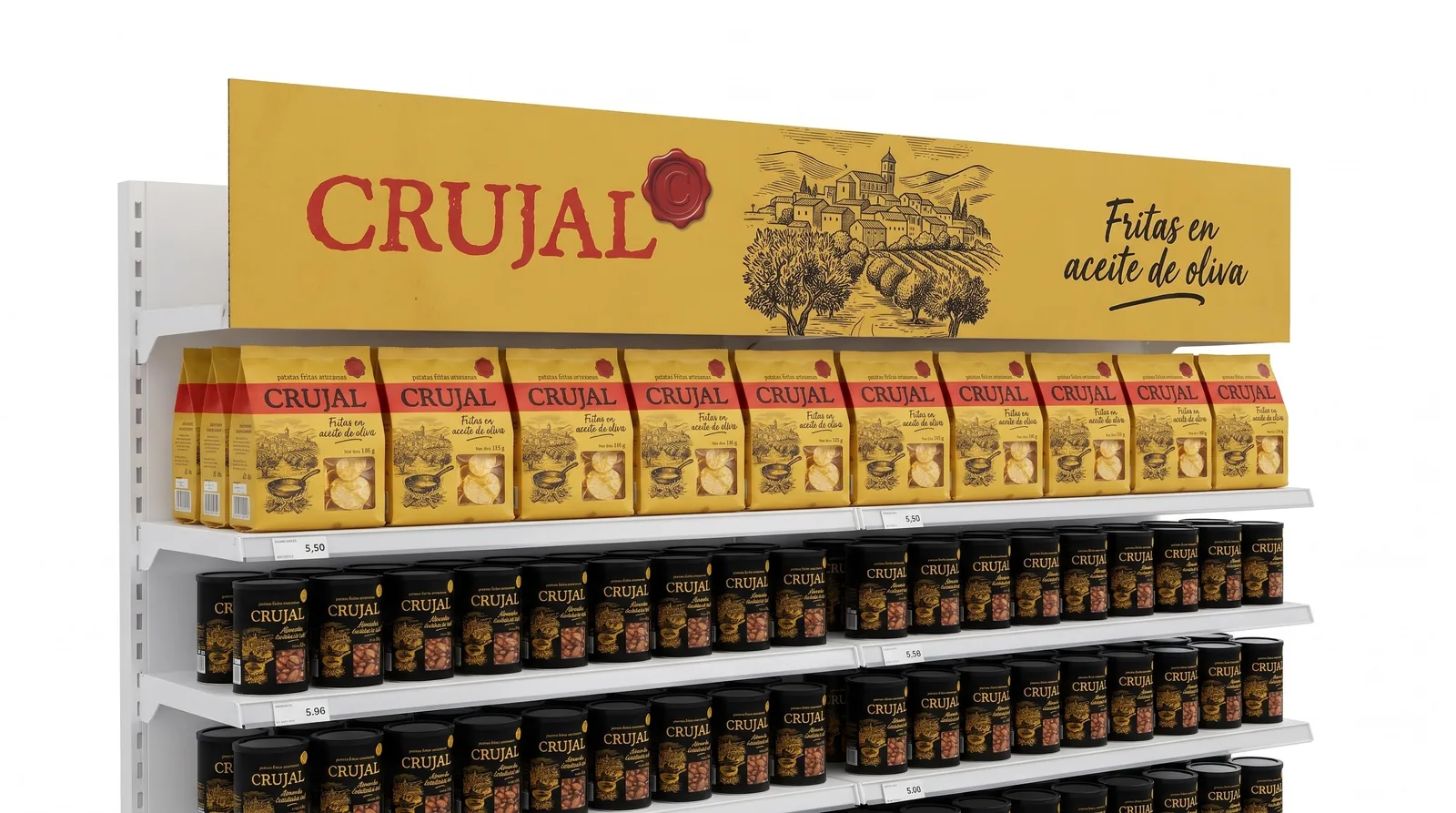
A banner strip is a long band that crowns the brand's section, with no profile and no slot. Crujal's is mustard yellow, with the logo in red, the wax seal, the village and olive trees from the pack and "Fritas en aceite de oliva" on the right. Below it sit the store's shelves, with the bags on the top one and the black canisters on the next ones. The bags and canisters come out just as they are, with their red band, their window and their black lid.
Shelf banner stripCrujal banner strip
- Material
- corrugated board
- Where
- on the snack aisle shelf, crowning Crujal's section
- Quantity
- 500, one per store
- Time in store
- March to June
- Installation
- store staff, on the top shelf of the section
- What it does
- makes Crujal's section visible from the aisle
On the shelf there is no fixture to build, so what matters is that the piece fits the retailer's shelving. If the goal were only to keep the section tidy, a shelf edge strip would do, and to say the brand is new, a wobbler. All four shelf pieces, and when to order each one, are in the guide to shelf strips and other shelf POP.
The endcap, two weeks in 80 stores
The endcap is the end of the gondola run that faces the main aisle. The structure and shelves belong to the retailer, and what the brand produces is the dressing. Crujal gets it in 80 stores for two weeks, the start of the launch.
Endcap displayCrujal endcap
- Material
- corrugated board
- Where
- at the end of the snack aisle, facing the main aisle
- What gets made
- the die-cut header, the side panel dressing and a strip for each shelf
- Product
- chip bags on the sides and almond canisters in the middle of each shelf
- Quantity
- 80, one per store
- Time in store
- two weeks
- Installation
- store staff, on the retailer's fixture
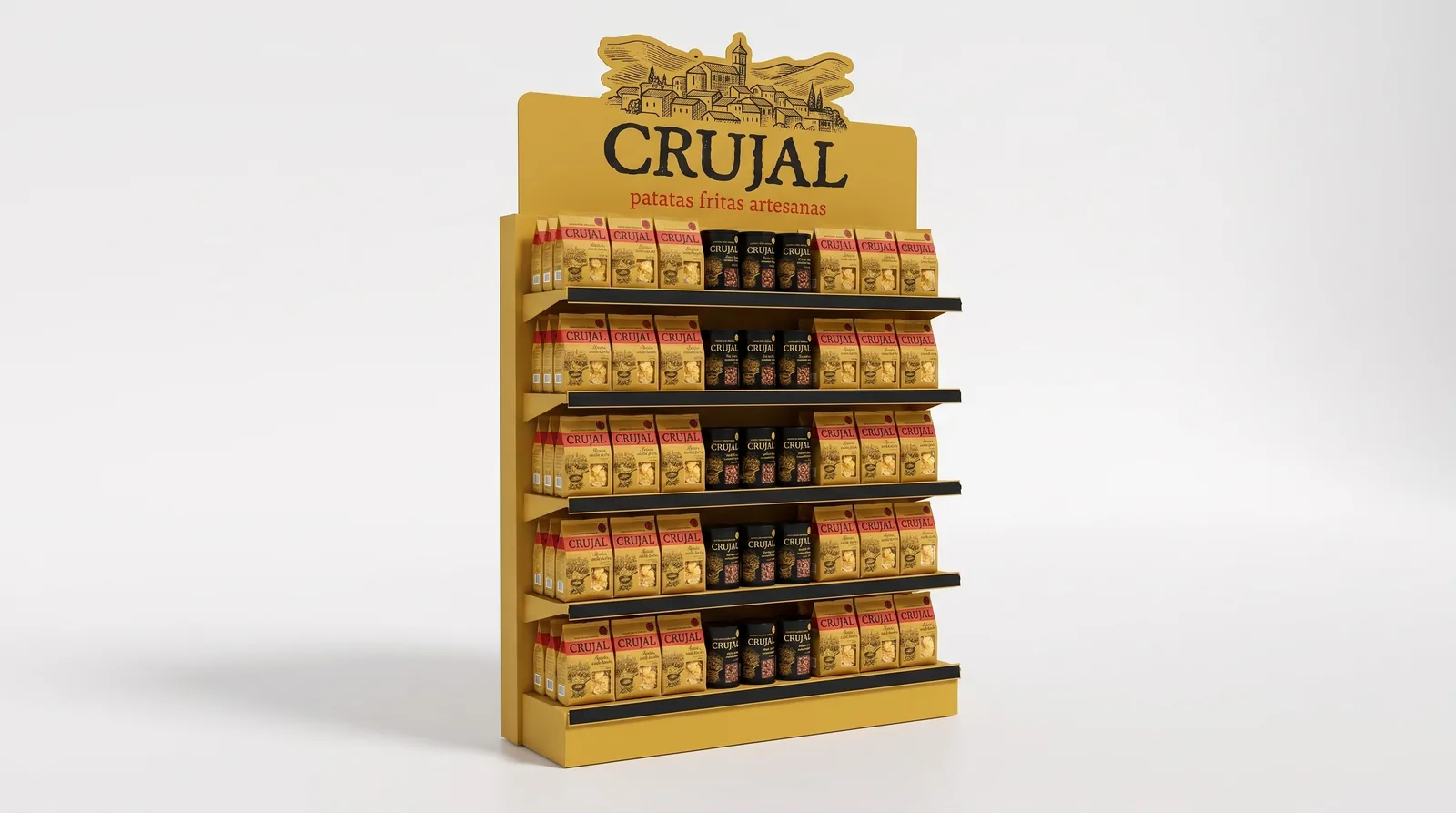
Crujal's is dressed in mustard yellow. The header is die-cut with the outline of the village and carries the logo and "patatas fritas artesanas", and each shelf has its black strip on the edge. On all five shelves, the bags sit on the sides and the canisters in the middle, so both products show at once from the main aisle.
Once the version is chosen, the next step is to see it where it will stand. I asked Bellto to put it at the end of the snack aisle.
Bellto applies the change to the version you picked and leaves everything else as it was. The endcap is the same, with the same header, the same strips and the same product, and what changes is the place. Next to it, the snack aisle carries other brands' bags, and Crujal's stands at the head of the aisle, where anyone walking the main aisle sees it.
It is the piece that depends most on the retailer's measurements. The header has to fit on top of the module, the dressing on its sides and each strip on the rail of its shelf. That is why it pays to get the module with its dimensions from the retailer, and not just the dates. What gets negotiated for an endcap, and what US and EU rules say about paying for display space, is in the same endcap vs floor display comparison.
The island, in the promotional area
In the 25 largest stores, Crujal gets four weeks of floor space in the promotional area by the entrance. An island display fits there, a floor display shoppers can reach from any side. The Cambridge Business English Dictionary defines it as a shelf that stands on its own in a store and shows products for sale on every side.
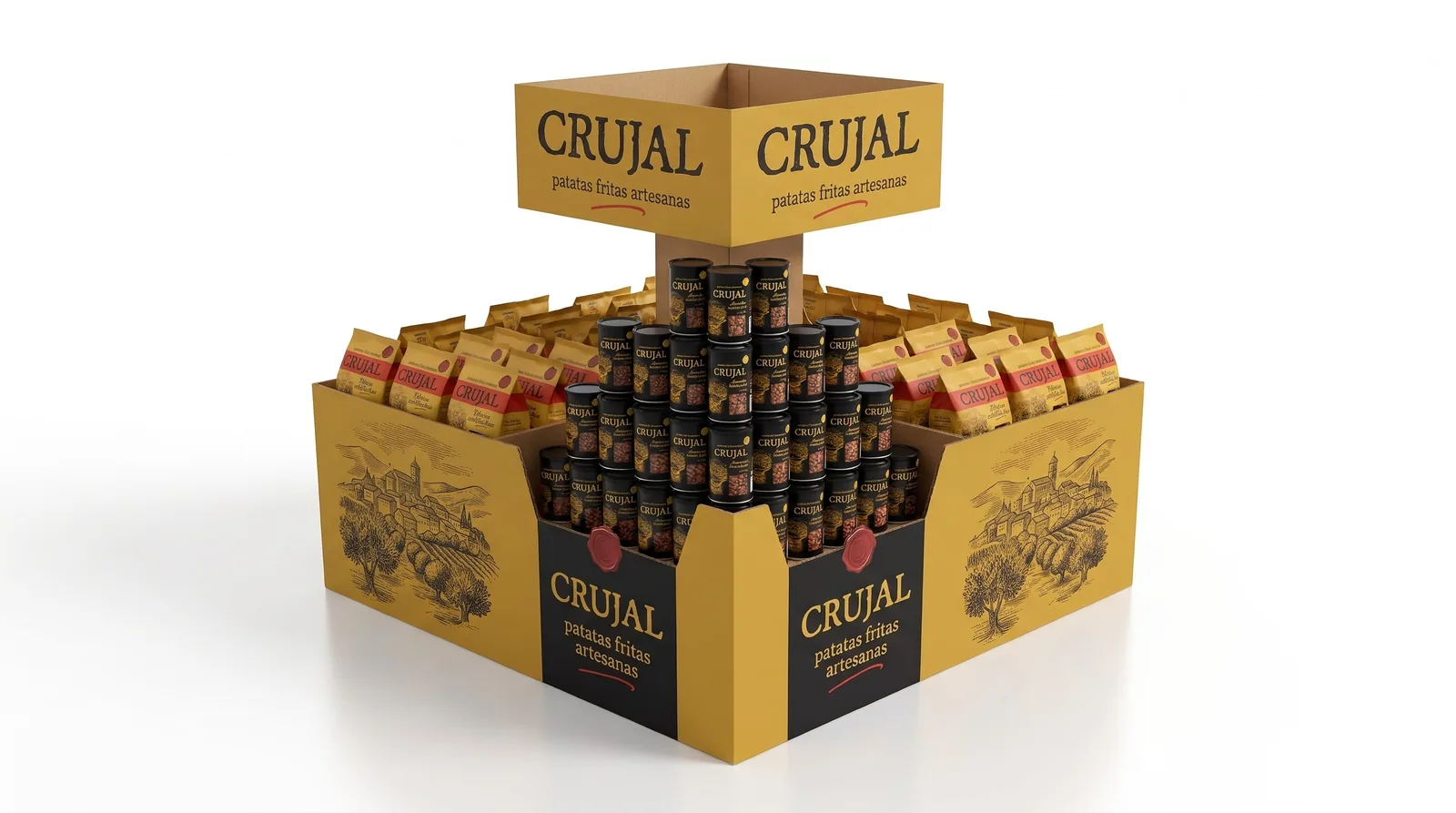
It is a low corrugated island in black and mustard yellow. Each face has a bin full of chip bags, the almond canisters are stacked in the middle and, on top, a four-sided sign repeats the logo for anyone coming from any direction. The sides carry the village and olive trees from the pack, and the black corners carry the logo and the wax seal. Of the versions Bellto designed, I would take this one, because it is low and leaves the promotional area visible over the top.
Island displayCrujal island display
- Material
- corrugated board
- Where
- in the promotional area by the entrance
- Product
- chip bags in the bins and almond canisters in the middle
- Quantity
- 25, one per large store
- Time in store
- four weeks
- Installation and restocking
- store staff
- What it does
- makes the launch visible as shoppers walk in, from all four sides
The island display and the pallet display take the same kind of spot, and they often get mixed up.
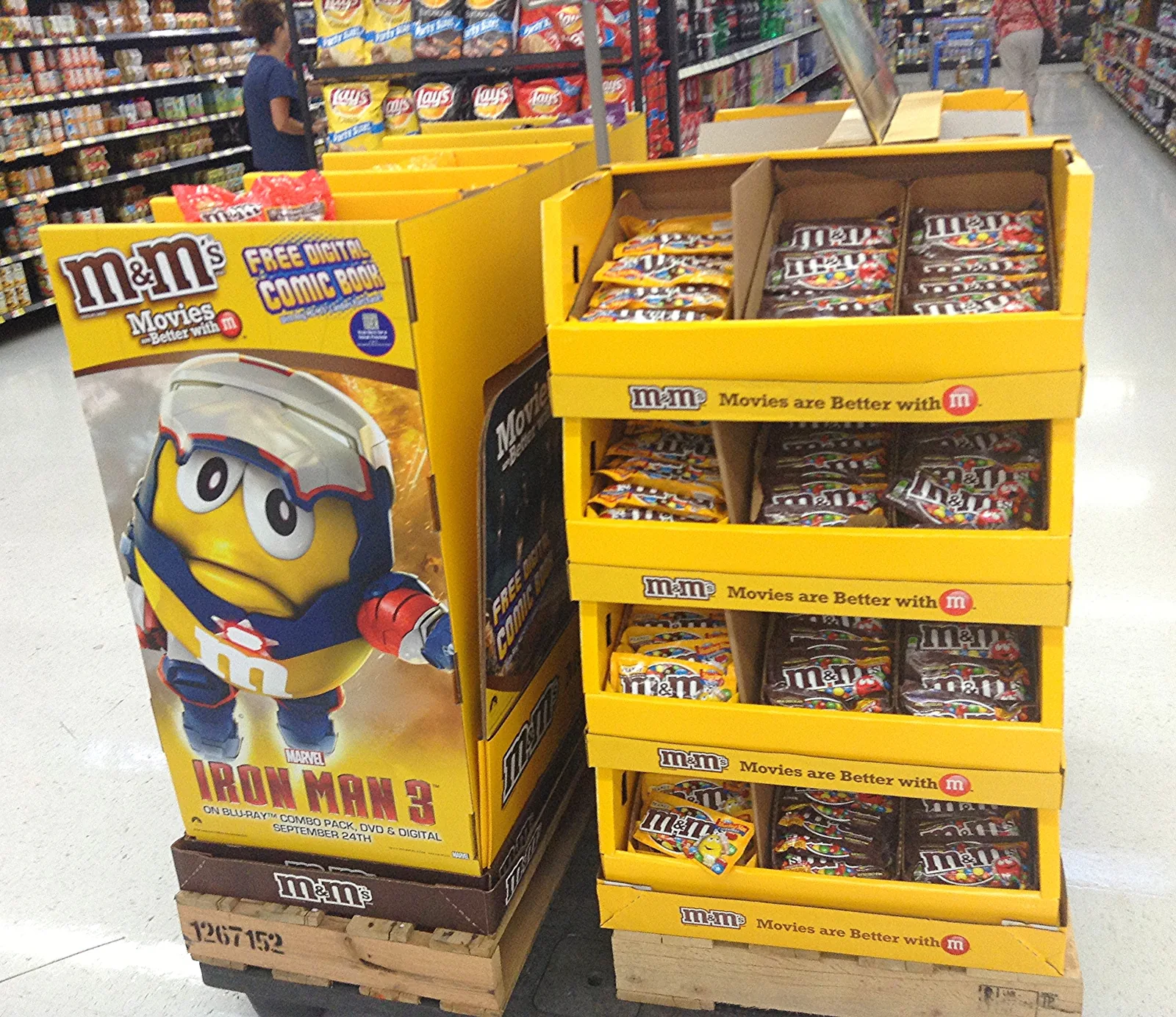
In the photo, the product has reached the store on its wooden pallet. The one on the left wears a printed skirt and the one on the right has stacked corrugated trays, and in both the board dresses the load. That is a pallet display. An island display is a fixture with its own bins or trays, set up in the store and filled with the product.
| Island display | Pallet display | |
|---|---|---|
| What it is | a free-standing floor display with bins or trays | the product stacked on its pallet, with a printed skirt and a header |
| How shoppers reach it | from every side | from the sides the spot leaves open |
| How it reaches the store | set up in the store and filled with the product | loaded, and placed as it is |
| What sets its size | the spot the retailer gives you | the pallet, full, half, quarter or sixth, and the maximum pallet height |
An island or a pallet takes floor space that people walk through, and that floor has rules. The rules belong to the building and the store is the one that complies, which is why the retailer decides where the piece fits.
| Where | Rule | What it says |
|---|---|---|
| US | ADA, Department of Justice primer for small businesses | the accessible route is at least three feet wide and must not be blocked by items such as display racks |
| US | OSHA, 29 CFR 1910.37 | no materials or equipment may be placed in an exit route, either permanently or temporarily |
| Spain | Spanish building code (CTE), DB SI, table 4.1 | in a store with more than 400 m² of sales area on the floor and shopping carts, aisles are at least 1.80 m wide, and 4 m between the checkouts and the shelving when there are more than 10 checkouts |
How to order POP for a supermarket campaign
A supermarket campaign goes to hundreds of stores of the same retailer, each group with a different space, and every missing detail gets multiplied by all of them. This is what the brief has to carry.
- The retailer, the number of stores and their formats
- What each group of stores gives you, shelf, endcap or floor, and for which dates
- The length of your shelf section and the price rail size, if there is a strip
- The endcap module, with its width, its height and how many shelves it has
- The size of the island or pallet spot, the maximum height and which sides are open
- The maximum pallet height and the pallet type, if there is a pallet display
- How many units of each piece, better as a range than as one number
- Who installs, who restocks and who removes the material
- The artwork, with the logo, the colors and the message of each piece
- The date it goes into stores and the date it comes out
With that information, a manufacturer can quote each piece without coming back to you, and the retailer knows what reaches each store.
What Bellto does with supermarket POP
Bellto knows more than 55 point of sale materials by name. Ask for a banner strip, an endcap or an island display, whatever your team calls it, and Bellto knows which piece it is, where it goes in the store and how it is held. In Bellto, Crujal's brief is the campaign's shared brief, and every piece has its own spec sheet. If the retailer changes the stores or the dates, you change them in one place and they apply to all three pieces.
Every version stays saved in its piece, ready to compare. When you pick one, Bellto splits the piece's design into its panels, in 4K, so your team reviews it next to the concept, and once you approve it, exports it as vectors in PNG, SVG, PDF or EPS. It generates the 3D model of the chosen version, in about 45 minutes, and recommends manufacturers for that piece from the more than 300 in its directory, with the reason for each one. The job only reaches the ones you pick, and the quote comes from the manufacturer.
The banner strip, which is flat, can go to a manufacturer that does printing and die-cutting, and the endcap and the island to one that makes corrugated floor pieces. In Bellto, each piece carries its own list.
I am building Bellto now. The waitlist is open to any brand, and I will soon start the first real campaigns with brands on the list, from start to finish. It opens by invitation, in small groups, with no card required.
Frequently asked questions
What POP displays can you put in a supermarket?
Whatever the retailer gives you in each store. With only the shelf, shelf pieces like a banner strip, a shelf edge strip, a shelf frame or a wobbler. With an endcap, its dressing. With floor space in an open area, an island display or a pallet display. Bellto, an AI agent that designs your brand's POP, creates them with your product.
What is the difference between an island display and a pallet display?
An island display is a floor display shoppers can reach from every side, with its own bins or trays, set in an open area of the store. A pallet display is the product stacked on its pallet and dressed with a printed skirt and a header, which arrives loaded and goes onto the floor as it is.
Where can an island display go in a grocery store?
Wherever the retailer gives you floor space, usually a promotional area or a wide aisle, and aisles have a minimum width. In the US, the Department of Justice's ADA primer for small businesses says the accessible route must be at least three feet wide and must not be blocked by display racks. In Spain, the building code asks for at least 1.80 m in the aisles of a supermarket with more than 400 m² of sales area on the floor and shopping carts.
What goes into a POP brief for a supermarket chain?
The retailer and the number of stores, what each group of stores gives you and for which dates, the endcap module, the island footprint, the maximum pallet height, the units as a range, who installs and restocks, the artwork and the in-store and removal dates.
Keep reading
Pharmacy display ideas for brands, from the counter to the shelf and the window
A pharmacy gives your brand three places, the counter, the shelf and the window, and one question comes first, what you sell. Which piece goes where, and what the rules say.
10 min read
Temporary vs permanent POP displays, and how campaign length picks the material
A POP display's material follows how long it has to stay in the store. Corrugated for a promotion, and MDF, metal or acrylic for a piece that stays.
11 min read
Best POP display manufacturers for your campaign in 2026
Five POP display manufacturers for a US brand, by material and piece. Euromon PLV, Cactus Containers, Sunbelt Displays, Bull Display Products and Creative Display Works.
6 min read- “Ironman 3 M&M's Promotional Tie In Floor Display at Walmart August 29 2013”, Mike Mozart · CC BY 2.0