Sustainable retail displays under the EU packaging regulation (PPWR)
The EU packaging regulation (PPWR) applies since August 12, 2026 and has no category for displays. When a display is packaging, who answers for it and what it requires.
In this article
I have been in the POP business for close to 4 years, and this guide reads the regulation from the brand's side, for any brand that sells into the EU. Which pieces of a campaign are packaging, who is responsible for them and what the text asks of them, each with its date. Everything comes from the regulation itself, from the guidance the Commission published in the Official Journal in June 2026 and from its FAQ, all linked at the end.
Bellto is an AI agent that designs your brand's POP. Every piece in this guide was designed by Bellto for Crujal, a fictional potato chip and nut brand I use on this blog.
What the PPWR is and when it applies
The PPWR is Regulation (EU) 2025/40 on packaging and packaging waste. It replaces Directive 94/62/EC, it was published in the Official Journal of the European Union on January 22, 2025, it entered into force on February 11, 2025 and it applies since August 12, 2026. Being a regulation, it binds every Member State the same way without waiting for a national law. It covers all packaging, whatever the material, including packaging used in retail.
Many obligations carry two dates, a fixed one and another that depends on the Commission first adopting a delegated or implementing act, and whichever comes later counts. That is why, in this guide, dates that depend on an act read "at the earliest".
In Spain, the Ministry for the Ecological Transition published a note on May 19, 2026 on how the regulation fits with Royal Decree 1055/2022 on packaging. Until a new royal decree is approved, the EU regulation rules, and the royal decree still applies where the regulation is silent or does not contradict it.
The Commission published guidance to interpret the regulation in the Official Journal of June 10, 2026 (C/2026/3084), and an FAQ in August. Neither one changes the text, and the guidance itself says the binding interpretation belongs to the Court of Justice of the European Union. Even so, they are the most complete official reading there is.
Is a display packaging?
The regulation defines packaging by what it does, not by what it is called. Packaging is any item, of any material, that an economic operator uses for the containment, protection, handling, delivery or presentation of products to another operator or to an end user. "Presentation" is on that list, which is why POP cannot be ruled out without looking at it piece by piece.
Annex I gives a list of examples of what is packaging and what is not, and not a single display appears in it. The Commission makes clear that the list is indicative and that the definition decides. For each item it asks you to check two things.
- Whether it is used to contain, protect, handle, deliver or present a product without being an integral part of it.
- Whether it is intended to be used, consumed or disposed of together with the product.
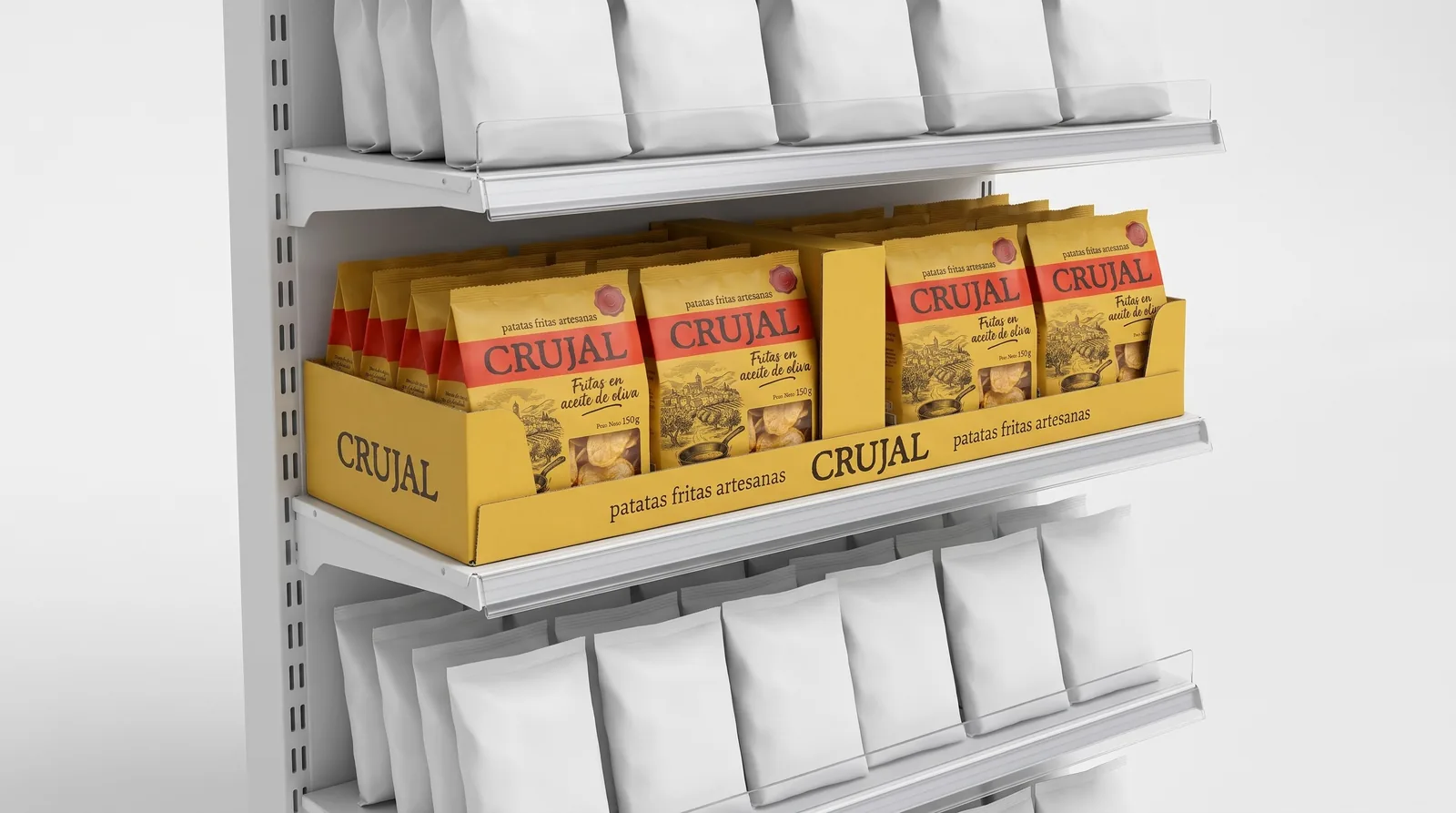
A second definition goes straight to POP. The regulation calls grouped packaging the packaging conceived to group a certain number of sales units at the point of sale, "irrespective of whether that grouping of sales units is sold as such to the end user or whether it serves as a means to facilitate the restocking of shelves at the point of sale". The Commission's FAQ adds that its purpose is typically facilitating stockkeeping or shelf display. A shelf tray that arrives full and goes onto the shelf as it is fits that definition.
| Piece | How it arrives and how it leaves | What the text says |
|---|---|---|
| Cardboard shelf tray | arrives full, goes onto the shelf as it is and is thrown out empty | groups sales units and serves to restock the shelf, the definition of grouped packaging |
| Pallet box or cardboard display that arrives full | arrives loaded on its pallet or in its case and is thrown out empty | groups sales units at the point of sale, the same definition |
| Neck hanger or tag hung on the product | hangs on the product or is attached to it and goes out with it | Annex I lists labels hung directly on or attached to a product among the items that are packaging |
| Wobbler, shelf strip or banner strip | sits on the store's shelf | does not contain the product or hang on it, and the regulation does not name it |
| Permanent metal, wood or acrylic fixture | stays in the store and is restocked with product from other shipments | presents the product but is not thrown away with it, and the regulation does not name it |
Here are the two ends of that table, with the same brand and in the same aisle.
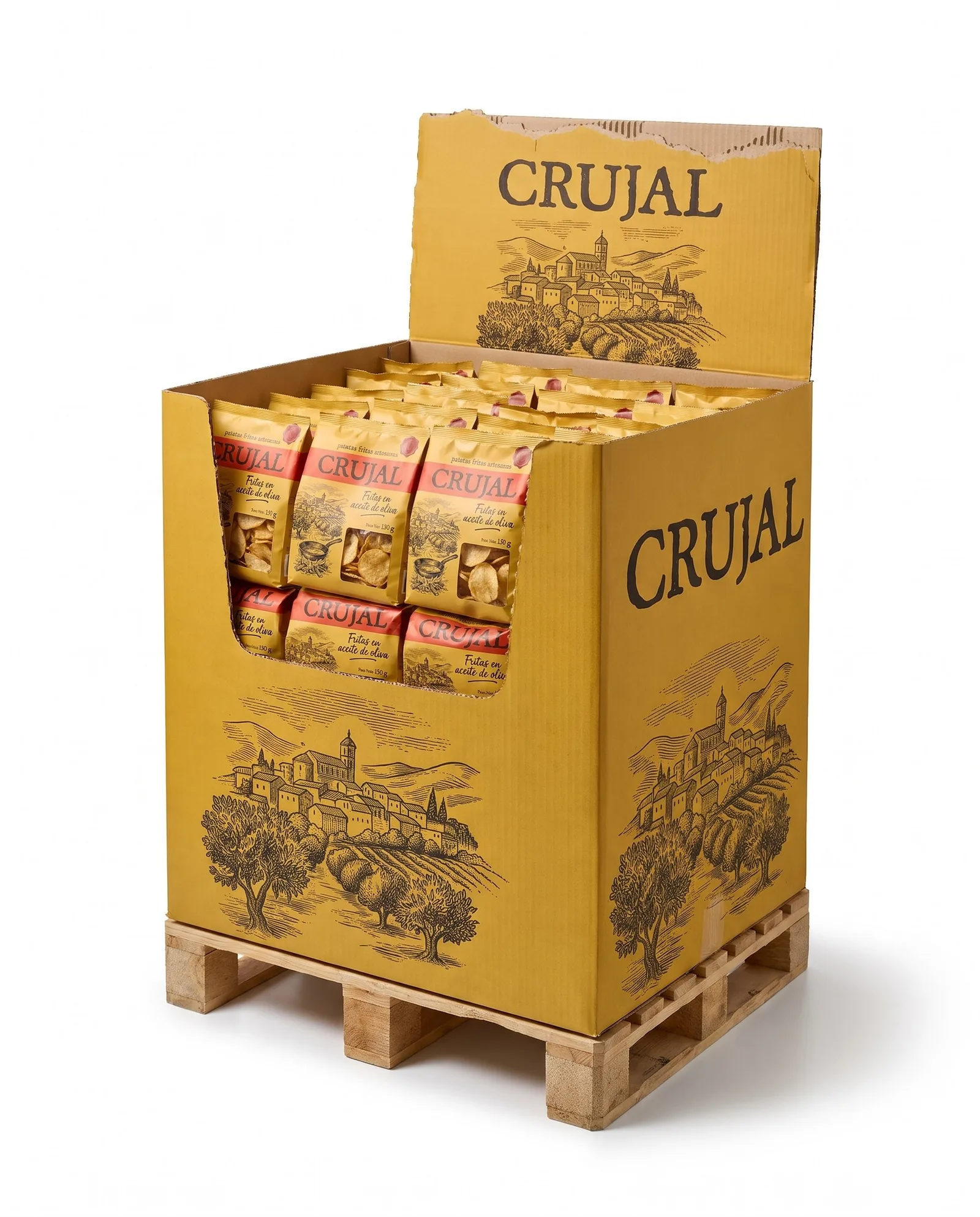
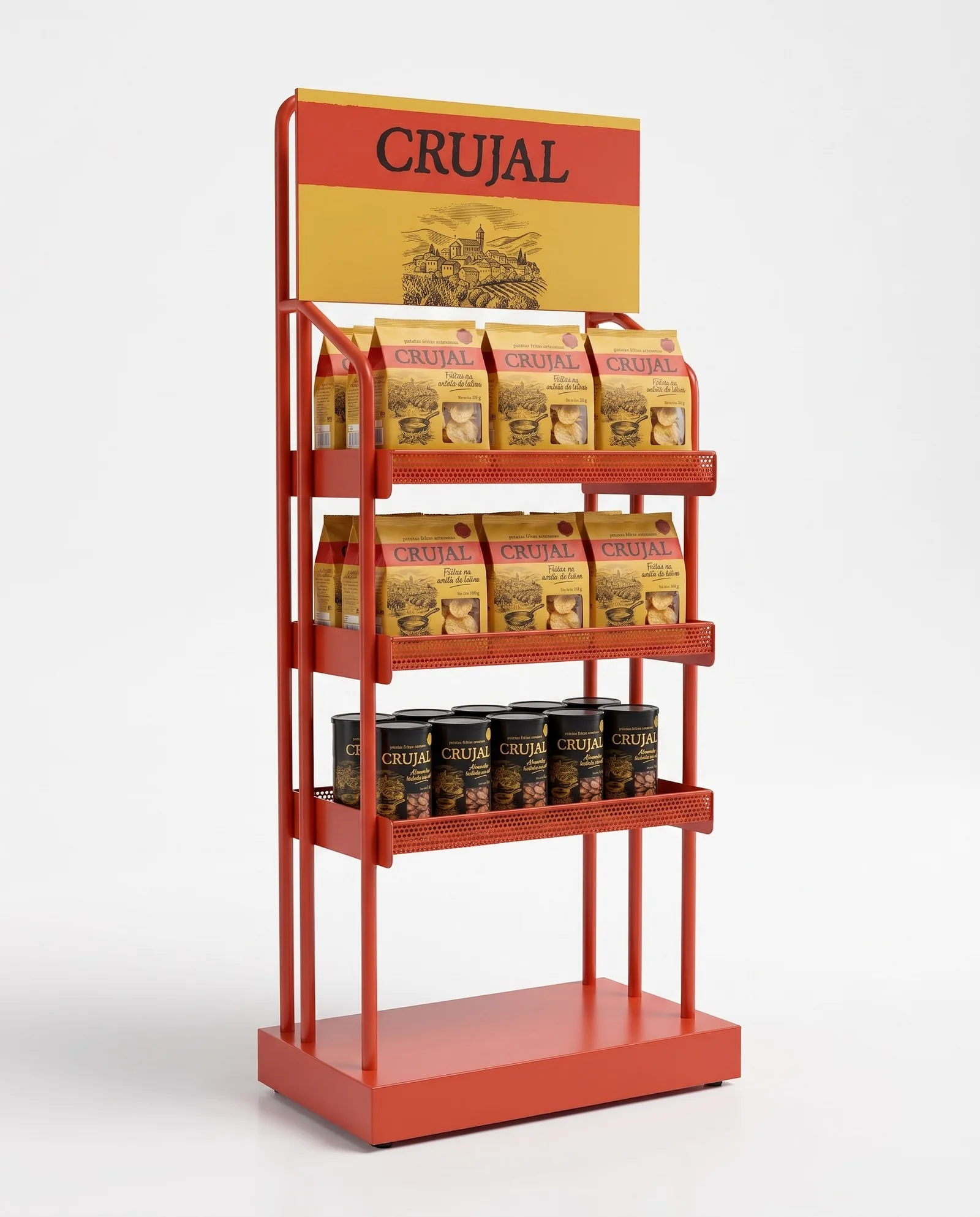
AI-generated image made with Bellto · fictional brand
The pallet box arrives at the store with the bags inside, opens along its perforated line and, once the last bag sells, it is taken away. It groups sales units and is disposed of once it is empty, so everything that follows in this guide applies to it. The metal display arrives empty only once and stays all year, and store staff restock it with bags that come in other cases. It presents the product, but it is not thrown away with it. Crujal's launch with cardboard pieces is in the endcap vs floor display comparison.
Between the two ends sits the cardboard display that ships empty and that store staff fill with product arriving separately. The regulation, the guidance and the FAQ say nothing about it. That is the one to review with whoever handles packaging at your company before you order it.
What all of this makes clear is that a POP campaign mixes pieces that are packaging and pieces that are not, and that the answer depends on what each one is and how it travels. Shelf POP works the same way, where the shelf strip, the banner strip, the shelf frame and the wobbler do different jobs on the same shelf.
If your display is packaging, the manufacturer is you
In the regulation, the manufacturer is not whoever makes the packaging. It is whoever has it designed or made under its own name or trademark, even if other trademarks show on it. The Commission's guidance spells it out. If the packaging carries a trademark, the owner of that trademark is presumed to be the manufacturer, and for sales and grouped packaging the manufacturer is normally the filler, who is often also the product brand owner.
For a shelf tray or a pallet box with your logo, the manufacturer is you, not the company that die-cut it. The guidance adds that there is only one manufacturer in the whole supply chain, and that it is the only operator legally responsible for the packaging meeting the sustainability and labeling requirements.
The exception is the micro-enterprise. If your company has fewer than 10 people and a turnover or balance sheet of up to 2 million euros, and whoever supplies the packaging is in your same Member State, the supplier becomes the manufacturer.
This is what Article 15 asks of the manufacturer.
- Only place on the market packaging that meets Articles 5 to 12 of the regulation
- Carry out, or have someone carry out, the conformity assessment before placing it on the market
- Draw up the technical documentation in Annex VII and the EU declaration of conformity
- Keep both for 5 years if the packaging is single-use, and 10 if it is reusable
- Make sure the packaging bears a type, batch or serial number that identifies it
- Make sure it shows your name or trademark and a postal address, on the packaging or in a QR code
The display maker comes into the regulation as a supplier. Article 16 requires it to give you all the information and documents you need to prove the packaging complies, including the technical documentation in Annex VII. And apart from the manufacturer there is the producer, which is whoever first makes the packaged product available in a Member State, registers there and pays for extended producer responsibility.
What the regulation asks of a display that is packaging
These are the obligations in the regulation that matter most for a POP piece that is packaging, with the date each one applies from.
| Requirement | From | What it looks at in the piece |
|---|---|---|
| Substances | August 12, 2026 | lead, cadmium, mercury and hexavalent chromium combined, at most 100 mg/kg in the package and its components (Article 5) |
| Recyclable | the general obligation, August 12, 2026 according to the Commission; the design criteria, January 1, 2030 at the earliest | that it can be recycled, with a recyclability grade of A, B or C, and from 2038 only A or B (Article 6) |
| Minimization | January 1, 2030 | weight and volume reduced to the minimum needed for its function (Article 10 and Annex IV) |
| Empty space | January 1, 2030 at the earliest | in grouped packaging, at most 50% empty space, and whoever fills it is the one who complies (Article 24) |
| Recycled plastic | January 1, 2030 at the earliest | each plastic part, a minimum of post-consumer recycled plastic, 35% in plastic packaging that is not contact-sensitive or a single-use beverage bottle (Article 7) |
| Label | August 12, 2028 at the earliest | a harmonized label with its material composition, based on pictograms, which transport packaging does not carry (Article 12) |
The design for recycling criteria will come in a delegated act that the Commission has to adopt by January 1, 2028. Until they apply, the guidance says manufacturers comply with the requirements of the previous directive and its harmonized standard.
Minimization is the one that touches POP the most. Recital 60 says marketing and consumer acceptance remain relevant for packaging design, but they should not justify extra weight and volume on their own. The Commission's guidance confirms it. Those two criteria were in the old standard and the regulation has taken them off the list. Annex IV does count, under packaging functionality, the particularities that give rise to its sale, such as gifts or seasonal events. In a cardboard display that is packaging, the weight and volume of the header, the side panels and every layer will have to be justified by those criteria, and looks alone are not enough.
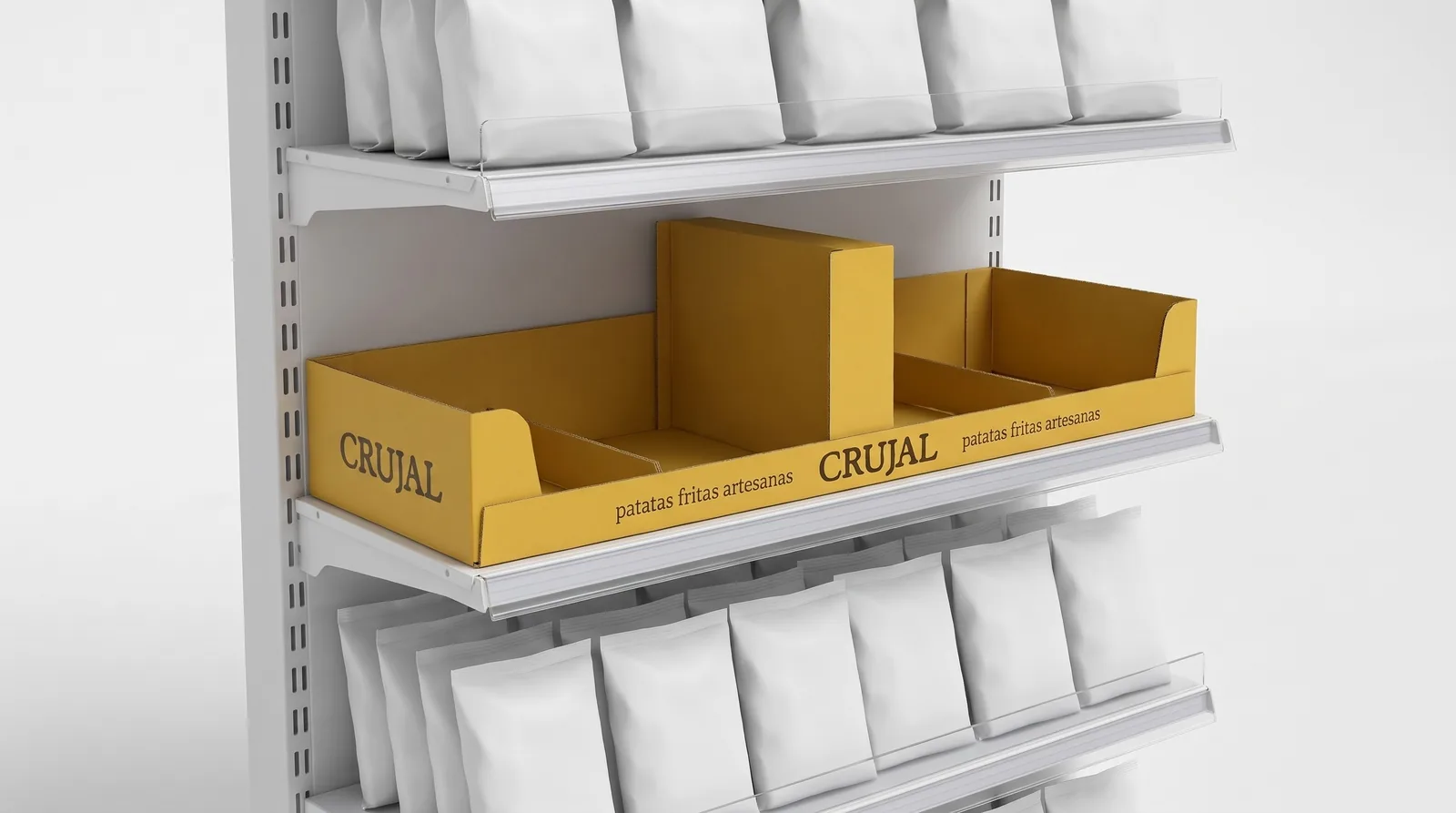
I asked Bellto for the same tray with no product, and this is what the regulation looks at. When the last bag sells, what stays on the shelf is the front panel, the sides and the center divider, and that is the packaging. Bellto applies the change to the version you picked and leaves the rest as it was, so the empty structure is the same one as the full one.
Material decides too. Annex II separates paper or cardboard packaging, where it lists boxes, trays and grouped packaging, from composite packaging that is mostly cardboard, which includes cardboard with plastic liners or windows. The design for recycling criteria will be set by those categories, so a plastic window on a cardboard display moves it into another category. How to order a cardboard piece for a campaign is in the Nutella Peanut launch with a cardboard floor display.
What to put in a display brief from now on
With the regulation in force, these are the lines worth adding to the brief for each piece. With them, the display maker can quote and prepare the Article 16 documents in the same order.
- Whether the piece arrives full from your warehouse or empty, and who fills it
- Whether it is thrown out once empty or stays in the store
- The material of each part, and if it has plastic, which kind
- Whether the cardboard has plastic windows, laminates or liners
- Who the manufacturer is under the regulation, your brand or your supplier if you are a micro-enterprise
- Where the batch number and your contact details go, on the piece or in a QR code
- The environmental claims you want printed on the piece
The last line matters. Article 12 bans labels, marks, symbols or inscriptions likely to mislead or confuse consumers about the sustainability requirements for the packaging, its other characteristics or how its waste is managed, where the regulation already sets a harmonized label. A "100% recyclable" on the header of a display that is packaging has to hold up.
What Bellto does with your campaign's POP
Bellto knows more than 55 point of sale materials by name. Call it whatever your team calls it, shelf tray, pallet box or floor display, and Bellto knows which piece you mean, where it goes in the store and how it is held. With the shared campaign brief, it creates every piece with your product, and every piece has its own spec sheet, with its material.
Every version stays saved in its piece, ready to compare, and Bellto applies each change to the version you picked, like the empty tray above. Once you approve the design, it splits the piece's artwork into its panels, in 4K, and exports it as vectors in PNG, SVG, PDF or EPS. It generates the 3D model of the chosen version in about 45 minutes. And it recommends manufacturers for that piece from the more than 300 in its directory, with the reason for each one. The job only reaches the ones you pick, and the quote comes from the manufacturer.
I am building Bellto now. The waitlist is open to any brand, and I will soon start the first real campaigns with brands on the list, from start to finish. It opens by invitation, in small groups, with no card required.
Frequently asked questions
Does the PPWR apply to retail displays?
It applies to all packaging, of any material, and it has no category for POP displays. A display is packaging when it presents your product and gets thrown away with it, like a cardboard shelf tray or pallet box that arrives at the store full. Bellto, an AI agent that designs your brand's POP, creates each of those pieces with your product.
When does the EU packaging regulation apply?
Since August 12, 2026. Other obligations come later. Minimization and the 50% maximum empty space in grouped packaging apply from January 1, 2030 at the earliest, and the harmonized material label from August 12, 2028 at the earliest.
Who is responsible for a display that is packaging, the brand or the display maker?
The regulation calls the manufacturer whoever has the packaging designed or made under its own name or trademark, and the Commission's guidance says that is the only operator responsible for compliance. If the display carries your brand, that is usually you, unless you are a micro-enterprise and your supplier is in your same country. The display maker has to give you the information and documents to prove it.
Is a permanent metal or wood display packaging?
The regulation does not name it. The Commission asks whether an item is used, consumed or disposed of together with the product, and a fixture that stays in the store and gets restocked with product from other shipments is not thrown away with it. The binding interpretation belongs to the Court of Justice of the European Union.
Keep reading
Temporary vs permanent POP displays, and how campaign length picks the material
A POP display's material follows how long it has to stay in the store. Corrugated for a promotion, and MDF, metal or acrylic for a piece that stays.
11 min read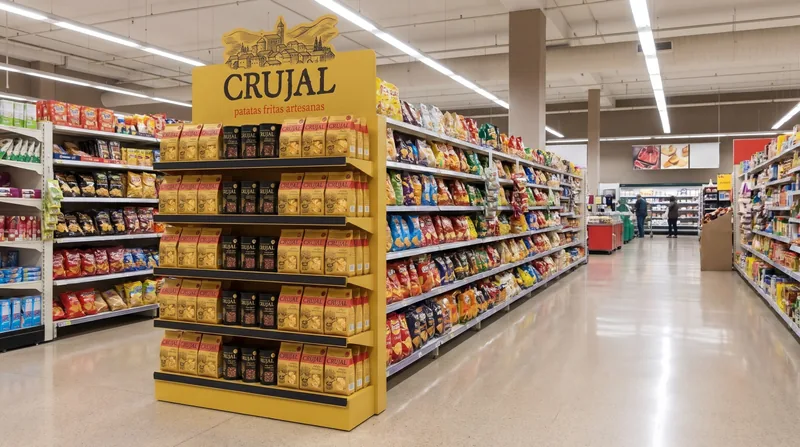
Supermarket POP displays for a grocery launch, from the shelf to the endcap and the island
Supermarket POP displays depend on what the retailer gives you, the shelf, an endcap for a few weeks or floor space for an island. Which piece goes where and how to order it.
12 min read
Best POP display manufacturers for your campaign in 2026
Five POP display manufacturers for a US brand, by material and piece. Euromon PLV, Cactus Containers, Sunbelt Displays, Bull Display Products and Creative Display Works.
6 min read- “Baal door Balenpers”, Romy2702 · CC BY-SA 3.0